Why Does Bread Rise? The Science in Your Kitchen
AdvancedFood & CookingGuion modelo de una presentación en inglés con traducción al español. Escucha y practica diapositiva por diapositiva.
Why Does Bread Rise?
The science in your kitchen
Model script
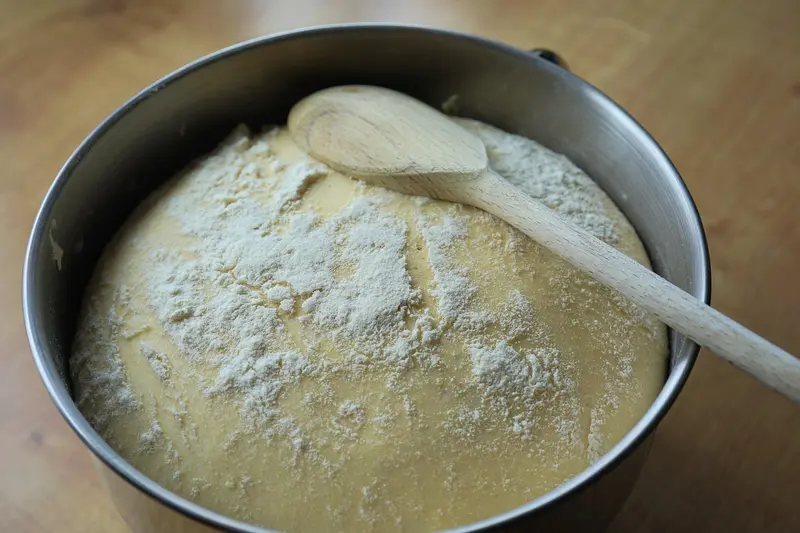
Good morning. I'm a chemistry teacher, and on weekends, I bake bread with my children. They always ask me, "Why does the dough get bigger?" Today, I'll explain the science, step by step.
Your recording
Say this slide out loud, then listen to yourself.
Recordings stay on this device and disappear when you leave the page.
Useful phrases
get bigger
Grow in size.
step by step
One stage at a time.
Full script
Read the whole talk.
All slides in one place. Read it through once, then practice slide by slide.
01Why Does Bread Rise?
Good morning. I'm a chemistry teacher, and on weekends, I bake bread with my children. They always ask me, "Why does the dough get bigger?" Today, I'll explain the science, step by step.
Buenos días. Soy profesora de química y los fines de semana hago pan con mis hijos. Siempre me preguntan: "¿Por qué la masa se hace más grande?". Hoy les voy a explicar la ciencia, paso a paso.
02Four Simple Ingredients
Basic bread needs only four ingredients: flour, water, salt, and yeast. The star of the story is yeast, which is a tiny living thing. It's actually a type of fungus, made of just one cell.
El pan básico necesita solo cuatro ingredientes: harina, agua, sal y levadura. La estrella de la historia es la levadura, que es un ser vivo diminuto. En realidad es un tipo de hongo, formado por una sola célula.
Source: Institute of Food Science & Technology (IFST), Love Food Love Science: "Raising agents: biological (fermentation)"
03Stage 1: Yeast Makes Gas
In the first stage, yeast feeds on sugars in the dough. As it feeds, it produces carbon dioxide gas and a little alcohol. This process is called fermentation.
En la primera etapa, la levadura se alimenta de los azúcares de la masa. Al alimentarse, produce gas de dióxido de carbono y un poco de alcohol. Este proceso se llama fermentación.
Source: Institute of Food Science & Technology (IFST), Love Food Love Science: "Raising agents: biological (fermentation)"
04Stage 2: Gluten Traps the Gas
But gas alone isn't enough. It needs to be trapped. When flour is mixed with water, two proteins in wheat form gluten. Kneading makes the gluten stretchy, like a net of tiny balloons that holds the gas.
Pero el gas solo no basta. Hay que atraparlo. Cuando la harina se mezcla con agua, dos proteínas del trigo forman el gluten. Amasar hace que el gluten se vuelva elástico, como una red de globos diminutos que retiene el gas.
Source: Exploratorium, "Science of Bread: Bread Science 101"
05Stage 3: The Oven
In the oven, the heat makes the gas expand, so the bread rises even more. The alcohol evaporates, and the yeast is killed by the heat. That's why baked bread doesn't keep growing.
En el horno, el calor hace que el gas se expanda, así que el pan crece todavía más. El alcohol se evapora y el calor mata la levadura. Por eso el pan horneado no sigue creciendo.
Source: Institute of Food Science & Technology (IFST), Love Food Love Science: "Raising agents: biological (fermentation)"
06Why Bread Sometimes Fails
This also explains why my first loaves were flat. If the water is too hot, it can kill the yeast before it starts. If you don't knead enough, the gas escapes. And if you're impatient, the yeast simply doesn't have time to work.
Esto también explica por qué mis primeros panes salieron planos. Si el agua está demasiado caliente, puede matar la levadura antes de que empiece. Si no se amasa lo suficiente, el gas se escapa. Y si uno es impaciente, la levadura simplemente no tiene tiempo de trabajar.
Sources: Institute of Food Science & Technology (IFST), Love Food Love Science: "Raising agents: biological (fermentation)"; Exploratorium, "Science of Bread: Bread Science 101"
07A Simple Way to Remember
Here's a simple way to remember it: yeast makes the gas, gluten holds the gas, and heat makes the gas grow. Three stages, one fluffy loaf.
Aquí tienen una forma sencilla de recordarlo: la levadura produce el gas, el gluten retiene el gas y el calor hace crecer el gas. Tres etapas, un pan esponjoso.
08Conclusion
In conclusion, every loaf of bread is a small science experiment with living things. Next time you eat a slice, think about the tiny workers that made it rise. Thank you.
En conclusión, cada pan es un pequeño experimento científico con seres vivos. La próxima vez que coman una rebanada, piensen en los diminutos trabajadores que lo hicieron crecer. Gracias.
Cover photo by webandi on Pixabay