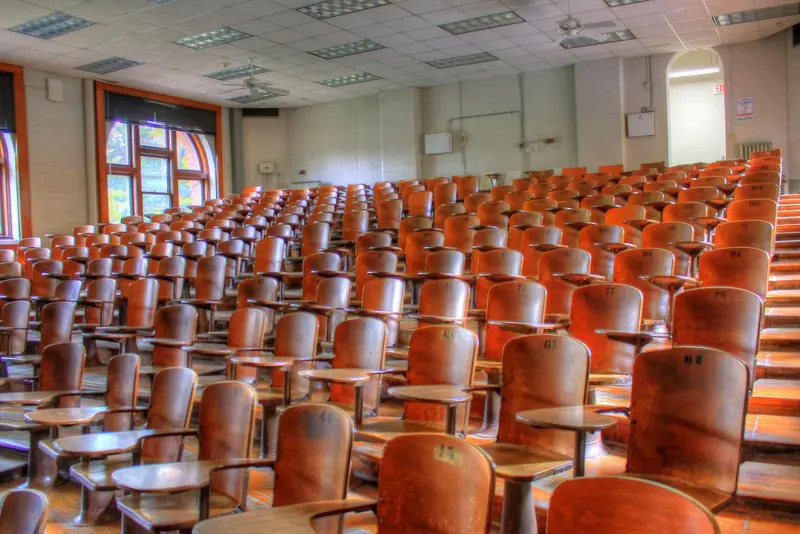
What If Classes Started at 10?
9 a.m. classes are hard
1 / 7
Model script
Hi, everyone. My first class starts at nine a.m., and every week, half the room looks half asleep. Last Monday, the student next to me fell asleep in the first ten minutes. Honestly, I almost did too. So today, I want to ask a simple question: what if all university classes started at ten a.m. instead? I'll share a small survey, then talk about the good points, the bad points, and my honest prediction.
Your recording
Say this slide out loud, then listen to yourself.
Recordings stay on this device and disappear when you leave the page.
Useful phrases
half asleep
Very sleepy; not fully awake.
what if
Used to imagine a different situation.
I almost did too
I nearly did the same thing.
Words
Highlighted words are on this slide. Tap a word to look it up on Google.
Full script
Read the whole talk.
All slides in one place. Read it through once, then practice slide by slide.
01What If Classes Started at 10?
Hi, everyone. My first class starts at nine a.m., and every week, half the room looks half asleep. Last Monday, the student next to me fell asleep in the first ten minutes. Honestly, I almost did too. So today, I want to ask a simple question: what if all university classes started at ten a.m. instead? I'll share a small survey, then talk about the good points, the bad points, and my honest prediction.
02I Asked My Classmates
First, I wanted to know if it was just me. So I asked twenty classmates one question: "Do you feel sleepy in your first class?" Fourteen said "often," four said "sometimes," and only two said "never." Interestingly, the two who said "never" both live very close to campus. It's a small survey, so I can't say it's true for every student. But it shows I'm not the only one.
The numbers on this slide are made up for practice. They are not real data.
03What Would Get Better
If classes started at ten, I think three things would get better. First, we would sleep a little more. Second, we would focus better in class. In fact, a 2017 study of about 190 university students, published in Frontiers in Human Neuroscience, suggested that the best start time for many students is after 11 a.m. And third, fewer students would come in late, because the trains would be less crowded by then.
Source: Evans, M. D. R., Kelley, P., & Kelley, J. (2017). "Identifying the Best Times for Cognitive Functioning Using New Methods: Matching University Times to Undergraduate Chronotypes." Frontiers in Human Neuroscience, 11, 188
04What Would Get Harder
But some things would get harder. Classes would end later in the evening, so students with part-time jobs would have less time to work. In my survey, eight of the twenty classmates have evening jobs, so this is a real problem. Clubs and sports would start later too. And not everyone is a night person. Some of my classmates actually feel best early in the morning.
The numbers on this slide are made up for practice. They are not real data.
05My Honest Prediction
Now, here's my honest prediction. Some of us would just stay up one hour later, and we'd be sleepy again. I know myself. If I don't have to get up early, I'll watch one more video at night. So a later start would help, but only if we also change our own habits, like using our phones less before bed.
06A Simple Test
So what should we do? I suggest a simple test. Let's try a ten a.m. start for one semester. At the end, we can ask the same question again and compare the results. We could also ask students with part-time jobs how it affected them. Then we'll know if it really works, instead of just guessing.
07Later Start, Better Habits
To sum up, starting classes at ten could help us sleep more and focus better. But it could make life harder for students with evening jobs, and the start time isn't everything. If we change the time and our habits together, nine a.m. sleepiness could become a thing of the past. Thank you. I'm happy to take your questions.
More School & Learning presentations



Cover photo by Goodfreephotos_com on Pixabay
Slide photos by 1767892 on Pixabay