Guion modelo de una presentación en inglés con traducción al español. Escucha y practica diapositiva por diapositiva.
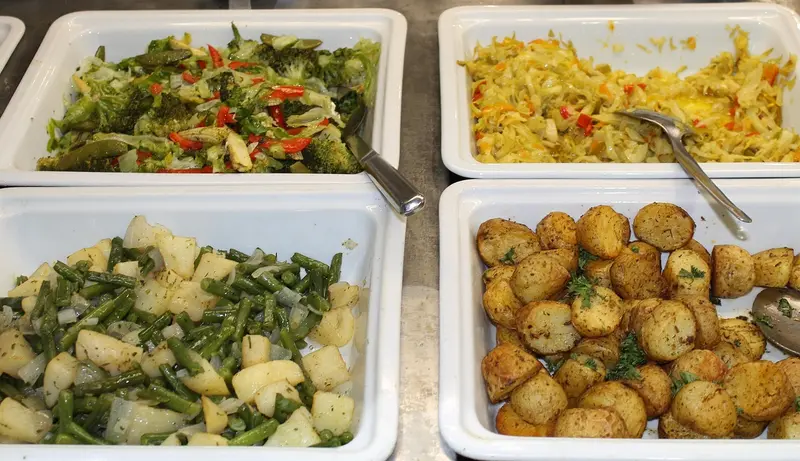
Two Countries, Two Lunches
How food is served
1 / 7
Model script
Hello, everyone. I went to elementary school in Japan, and in high school, I spent one year as an exchange student in the United States. So I've eaten school lunch in both countries, and they felt very different. Today, I'll compare them in three ways. First, how the food is served. Second, what lunch is for. Third, who it helps. Finally, I'll tell you what I think each country does best.
Your recording
Say this slide out loud, then listen to yourself.
Recordings stay on this device and disappear when you leave the page.
Useful phrases
I've eaten school lunch in both countries
Shows you have personal experience of both.
I'll compare them in three ways
Tells the audience the structure of your talk.
what I think each country does best
Your view of each one's strongest point.
Words
- exchange student
- food education
- shokuiku
- cafeteria
- skipped
- local vegetables
- fiscal year
- reduced price
- safety net
Highlighted words are on this slide. Tap a word to look it up on Google.
Full script
Read the whole talk.
All slides in one place. Read it through once, then practice slide by slide.
01Two Countries, Two Lunches
Hello, everyone. I went to elementary school in Japan, and in high school, I spent one year as an exchange student in the United States. So I've eaten school lunch in both countries, and they felt very different. Today, I'll compare them in three ways. First, how the food is served. Second, what lunch is for. Third, who it helps. Finally, I'll tell you what I think each country does best.
Hola a todos. Fui a la escuela primaria en Japón y, en la secundaria, pasé un año como estudiante de intercambio en Estados Unidos. Así que he comido el almuerzo escolar en los dos países, y me parecieron muy diferentes. Hoy los voy a comparar de tres maneras. Primero, cómo se sirve la comida. Segundo, para qué sirve el almuerzo. Tercero, a quién ayuda. Por último, les diré lo que, en mi opinión, hace mejor cada país.
02Two Long Histories
First, some background. Both countries have had national school lunch laws for a long time. In the United States, the National School Lunch Act was passed in 1946. In Japan, the School Lunch Act was passed in 1954. Then, in 2008, Japan changed the law to add the goal of food education, or shokuiku. This means lunch is officially a part of learning, not just a meal.
Primero, un poco de contexto. Los dos países tienen leyes nacionales de almuerzo escolar desde hace mucho tiempo. En Estados Unidos, la Ley Nacional de Almuerzos Escolares se aprobó en 1946. En Japón, la Ley de Almuerzos Escolares se aprobó en 1954. Luego, en 2008, Japón cambió la ley para añadir el objetivo de la educación alimentaria, o shokuiku. Esto significa que el almuerzo es oficialmente parte del aprendizaje, no solo una comida.
Sources: USDA Economic Research Service, "National School Lunch Program": the program was established under the National School Lunch Act, signed in 1946; Ministry of Education, Culture, Sports, Science and Technology (MEXT), Japan: the School Lunch Act was enacted in 1954 and amended in 2008 (in force April 2009) to add the promotion of shokuiku (food education) to its purpose
03Point 1: How the Food Is Served
My first point is how the food is served. In my Japanese school, we ate in our classroom. Every week, a few students wore white coats and served the food to everyone else, and then we all cleaned up together. In my American school, on the other hand, we walked through a cafeteria line and chose our food. I liked having choices, but I noticed many students skipped the vegetables. So Japan teaches teamwork, while the U.S. gives students more choice.
Mi primer punto es cómo se sirve la comida. En mi escuela japonesa, comíamos en el aula. Cada semana, algunos estudiantes se ponían batas blancas y servían la comida a los demás, y luego todos limpiábamos juntos. En mi escuela estadounidense, en cambio, pasábamos por una fila en la cafetería y elegíamos nuestra comida. Me gustaba poder elegir, pero noté que muchos estudiantes no tomaban las verduras. Así que Japón enseña trabajo en equipo, mientras que Estados Unidos da a los estudiantes más opciones.
04Point 2: What Lunch Is For
My second point is what lunch is for. In Japan, because of the 2008 change to the law, lunch is part of food education. At my school, the menu often had local vegetables, and our teacher explained where the food came from. In the U.S., lunch felt more like a quick break. We had about 25 minutes, and many people just ate and talked. Both are fine, but Japan clearly uses lunch as a lesson.
Mi segundo punto es para qué sirve el almuerzo. En Japón, gracias al cambio de la ley en 2008, el almuerzo es parte de la educación alimentaria. En mi escuela, el menú a menudo tenía verduras locales, y nuestra maestra nos explicaba de dónde venía la comida. En Estados Unidos, el almuerzo se sentía más como un descanso rápido. Teníamos unos 25 minutos, y mucha gente solo comía y charlaba. Las dos formas están bien, pero Japón claramente usa el almuerzo como una lección.
Source: Ministry of Education, Culture, Sports, Science and Technology (MEXT), Japan: the School Lunch Act was amended in 2008 (in force April 2009) to add the promotion of shokuiku (food education) to its purpose
05Point 3: Who It Helps
My third point is who school lunch helps. In the U.S., the program is very large. According to the U.S. Department of Agriculture, it served more than 4.8 billion lunches in fiscal year 2024. And 72.4% of those lunches were free or reduced price. This shows that in the U.S., school lunch is an important safety net. For many families, it means their children get at least one full meal every school day.
Mi tercer punto es a quién ayuda el almuerzo escolar. En Estados Unidos, el programa es enorme. Según el Departamento de Agricultura de Estados Unidos, sirvió más de 4.8 mil millones de almuerzos en el año fiscal 2024. Y el 72.4% de esos almuerzos fueron gratuitos o a precio reducido. Esto muestra que, en Estados Unidos, el almuerzo escolar es una red de seguridad importante. Para muchas familias, significa que sus hijos comen al menos una comida completa cada día de clase.
Source: USDA Economic Research Service, "National School Lunch Program": in fiscal year 2024, the program provided more than 4.8 billion lunches; 72.4% of lunches were served free or at a reduced price
06Is Japan's Lunch Simply Better?
Some people say Japan's school lunch is simply better. That's fair in some ways. The meals I ate in Japan were healthier, and I learned a lot from serving and cleaning. But I don't think it's that simple. The U.S. program feeds a huge number of children, and for many of them, it's the most reliable meal of the day. And choosing your own food also teaches something: making decisions. In my view, the two countries are trying to do different jobs.
Algunas personas dicen que el almuerzo escolar de Japón es simplemente mejor. En algunos aspectos, es justo. Las comidas que comí en Japón eran más saludables, y aprendí mucho sirviendo y limpiando. Pero no creo que sea tan sencillo. El programa de Estados Unidos alimenta a una cantidad enorme de niños, y para muchos de ellos es la comida más segura del día. Y elegir tu propia comida también enseña algo: a tomar decisiones. En mi opinión, los dos países intentan cumplir funciones diferentes.
07What Each Country Does Best
To sum up, Japan and the U.S. serve school lunch in very different ways. Japan does best at using lunch as a lesson, with teamwork and food education. The U.S. does best at using lunch as a safety net for millions of families. If I could mix them, I'd take Japan's classroom lunch and America's free meals for families who need them. Thank you for listening. Do you have any questions?
En resumen, Japón y Estados Unidos sirven el almuerzo escolar de formas muy diferentes. Lo que mejor hace Japón es usar el almuerzo como una lección, con trabajo en equipo y educación alimentaria. Lo que mejor hace Estados Unidos es usar el almuerzo como red de seguridad para millones de familias. Si pudiera mezclarlos, tomaría el almuerzo en el aula de Japón y las comidas gratuitas de Estados Unidos para las familias que las necesitan. Gracias por su atención. ¿Tienen alguna pregunta?
More School & Learning presentations




Cover photo by AlbanyColley on Pixabay
Slide photos by congerdesign on Pixabay