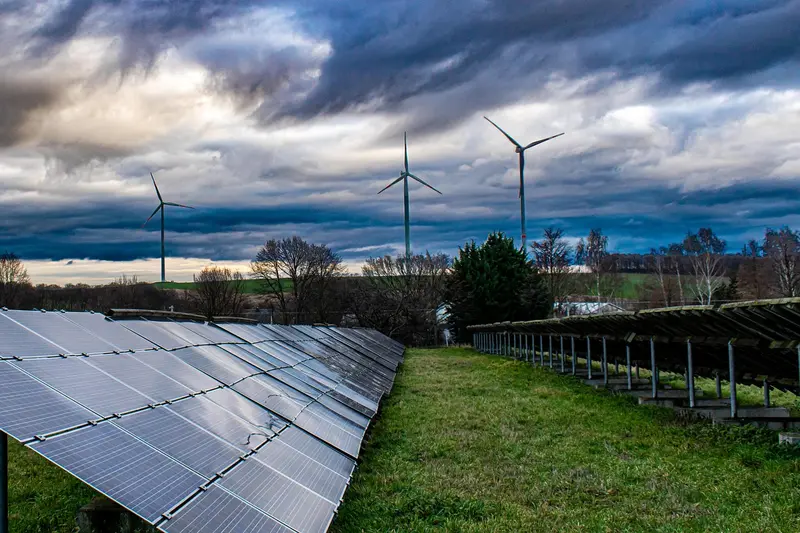
Where Will Our Electricity Come From?
Where we are now
1 / 8
Model script
Good morning, everyone. Every time you charge your phone, the electricity comes from somewhere. For many of us, it still comes from burning coal and gas. But that is changing, and it's changing fast. Today, I'd like to make a prediction about where our electricity will come from in 2050. First, I'll show you where we are now. Then, I'll look at a forecast for 2030 and the role of batteries. After that, I'll talk about the biggest problem. Finally, I'll give you my own prediction.
Your recording
Say this slide out loud, then listen to yourself.
Recordings stay on this device and disappear when you leave the page.
Useful phrases
I'd like to make a prediction
I want to say what I think will happen.
it's changing fast
It is changing quickly.
Finally, I'll give you
My last point will be...
Words
Highlighted words are on this slide. Tap a word to look it up on Google.
Full script
Read the whole talk.
All slides in one place. Read it through once, then practice slide by slide.
01Where Will Our Electricity Come From?
Good morning, everyone. Every time you charge your phone, the electricity comes from somewhere. For many of us, it still comes from burning coal and gas. But that is changing, and it's changing fast. Today, I'd like to make a prediction about where our electricity will come from in 2050. First, I'll show you where we are now. Then, I'll look at a forecast for 2030 and the role of batteries. After that, I'll talk about the biggest problem. Finally, I'll give you my own prediction.
02Where We Are Now
Let's start with where we are now. According to Ember's Global Electricity Review 2025, renewable sources made about 32% of the world's electricity in 2024. Hydropower is still the biggest renewable source, at about 14%, followed by wind at about 8% and solar at about 7%. If we add nuclear power, clean sources reached 40.9%. Solar grew the most. It added 474 terawatt-hours in just one year, the biggest jump ever recorded. This shows that the change isn't just a plan for the future. It's already happening, and it's speeding up.
Source: Ember, "Global Electricity Review 2025" (April 2025; wind 8.1%, solar 6.9%, hydro 14.3%, other renewables 2.6%; clean power 40.9%; solar +474 TWh, the largest annual growth on record)
03The Forecast for 2030
My second point is the forecast. The International Energy Agency, or IEA, published a report called Renewables 2024. It forecasts that renewables will rise from 30% of global electricity in 2023 to 46% in 2030. Solar and wind make up almost all of this growth. In other words, in just seven years, almost half of the world's electricity could come from renewables. In my view, if this trend continues after 2030, renewables will become the main source of electricity well before 2050.
Source: International Energy Agency (IEA), "Renewables 2024", Global overview (October 2024; renewable share of electricity forecast to expand from 30% in 2023 to 46% in 2030; solar and wind make up almost all this growth)
04Batteries Solve the Night Problem
Now, you might ask: what happens at night, or on a day with no wind? This is where batteries come in. According to the IEA's 2024 report on batteries, the cost of lithium-ion batteries has fallen by about 90% since 2010. And in 2023, the amount of battery storage added to power systems more than doubled. Cheaper batteries mean that solar power from a sunny afternoon can be used in the evening. This matters because it makes solar and wind much more reliable.
Source: International Energy Agency (IEA), "Batteries and Secure Energy Transitions" (April 2024; 90% cost reductions since 2010; battery storage in the power sector more than doubled year-on-year in 2023)
05The Biggest Problem: Rising Demand
However, there's a strong argument on the other side. Electricity demand is also growing quickly. Ember reports that global demand rose by 4% in 2024, and heatwaves caused nearly a fifth of that increase, as people used more air conditioning. Because of this, power from fossil fuels also went up a little, and emissions from electricity reached a record 14.6 billion tonnes of CO2. In short, clean power is growing, but demand is growing too. This is the most serious reason to doubt a fast change.
Source: Ember, "Global Electricity Review 2025" (April 2025; demand +4.0% in 2024, with heatwaves adding nearly a fifth of the increase; fossil generation +1.4%; power sector emissions a record 14.6 billion tonnes of CO2)
06What I Saw at My Grandparents' House
This reminds me of my grandparents. Five years ago, they put solar panels on the roof of their house in the countryside. At first, they could only use the power during the day. Last year, they added a home battery. Now, they use their own solar power in the evening, too, and my grandfather says his electricity bill is much lower. For me, this small example shows how the pieces fit together: solar power plus batteries. It also shows that the change can start at home, not only in big power plants.
07My Prediction for 2050
So, here is my prediction. This is my own view, not an official forecast. I think that by 2050, most of the world's electricity will come from solar and wind, supported by batteries, hydropower, and some nuclear power. But I don't think coal and gas will disappear completely. Some countries will probably still need them as a backup, especially in winter, or when demand suddenly jumps. In other words, renewables will be the main source, but not the only one.
08Mostly Clean by 2050
To sum up, renewables already make about a third of the world's electricity. The IEA expects almost half by 2030, and cheaper batteries are solving the night problem. Growing demand is still the biggest challenge. That's why I predict a mostly clean, but not fully clean, power system in 2050. Thank you for listening. I'm happy to take your questions.
Sources: Ember, "Global Electricity Review 2025" (April 2025); International Energy Agency (IEA), "Renewables 2024" (October 2024); International Energy Agency (IEA), "Batteries and Secure Energy Transitions" (April 2024)
More Environment & Nature presentations

Cover photo by Coernl on Pixabay