Guion modelo de una presentación en inglés con traducción al español. Escucha y practica diapositiva por diapositiva.
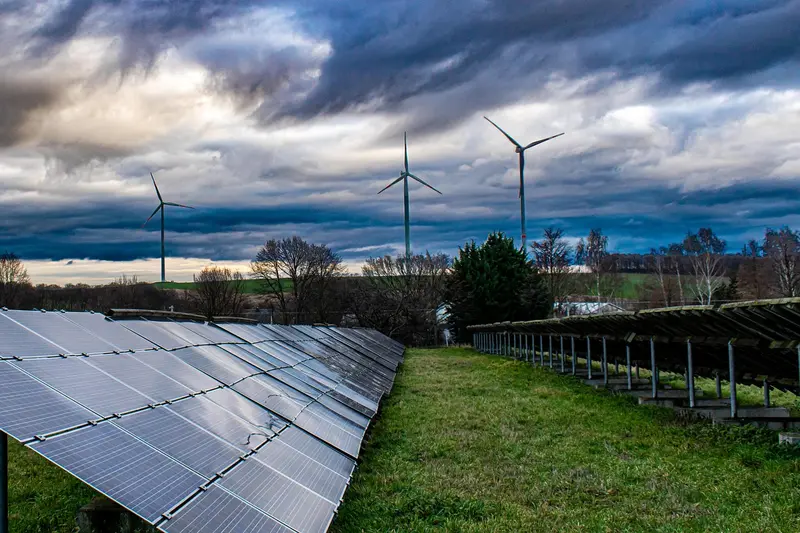
Where Will Our Electricity Come From?
Where we are now
1 / 8
Model script
Good morning, everyone. Every time you charge your phone, the electricity comes from somewhere. For many of us, it still comes from burning coal and gas. But that is changing, and it's changing fast. Today, I'd like to make a prediction about where our electricity will come from in 2050. First, I'll show you where we are now. Then, I'll look at a forecast for 2030 and the role of batteries. After that, I'll talk about the biggest problem. Finally, I'll give you my own prediction.
Your recording
Say this slide out loud, then listen to yourself.
Recordings stay on this device and disappear when you leave the page.
Useful phrases
I'd like to make a prediction
I want to say what I think will happen.
it's changing fast
It is changing quickly.
Finally, I'll give you
My last point will be...
Words
Highlighted words are on this slide. Tap a word to look it up on Google.
Full script
Read the whole talk.
All slides in one place. Read it through once, then practice slide by slide.
01Where Will Our Electricity Come From?
Good morning, everyone. Every time you charge your phone, the electricity comes from somewhere. For many of us, it still comes from burning coal and gas. But that is changing, and it's changing fast. Today, I'd like to make a prediction about where our electricity will come from in 2050. First, I'll show you where we are now. Then, I'll look at a forecast for 2030 and the role of batteries. After that, I'll talk about the biggest problem. Finally, I'll give you my own prediction.
Buenos días a todos. Cada vez que cargan su teléfono, la electricidad viene de algún lugar. Para muchos de nosotros, todavía viene de quemar carbón y gas. Pero eso está cambiando, y está cambiando rápido. Hoy me gustaría hacer una predicción sobre de dónde vendrá nuestra electricidad en 2050. Primero, les mostraré dónde estamos ahora. Luego, veré un pronóstico para 2030 y el papel de las baterías. Después, hablaré del mayor problema. Por último, les daré mi propia predicción.
02Where We Are Now
Let's start with where we are now. According to Ember's Global Electricity Review 2025, renewable sources made about 32% of the world's electricity in 2024. Hydropower is still the biggest renewable source, at about 14%, followed by wind at about 8% and solar at about 7%. If we add nuclear power, clean sources reached 40.9%. Solar grew the most. It added 474 terawatt-hours in just one year, the biggest jump ever recorded. This shows that the change isn't just a plan for the future. It's already happening, and it's speeding up.
Empecemos por dónde estamos ahora. Según el Global Electricity Review 2025 de Ember, las fuentes renovables produjeron alrededor del 32% de la electricidad del mundo en 2024. La energía hidroeléctrica sigue siendo la mayor fuente renovable, con alrededor del 14%, seguida por la eólica con alrededor del 8% y la solar con alrededor del 7%. Si sumamos la energía nuclear, las fuentes limpias llegaron al 40.9%. La solar fue la que más creció. Aumentó 474 teravatios hora en solo un año, el mayor salto jamás registrado. Esto muestra que el cambio no es solo un plan para el futuro. Ya está ocurriendo, y se está acelerando.
Source: Ember, "Global Electricity Review 2025" (April 2025; wind 8.1%, solar 6.9%, hydro 14.3%, other renewables 2.6%; clean power 40.9%; solar +474 TWh, the largest annual growth on record)
03The Forecast for 2030
My second point is the forecast. The International Energy Agency, or IEA, published a report called Renewables 2024. It forecasts that renewables will rise from 30% of global electricity in 2023 to 46% in 2030. Solar and wind make up almost all of this growth. In other words, in just seven years, almost half of the world's electricity could come from renewables. In my view, if this trend continues after 2030, renewables will become the main source of electricity well before 2050.
Mi segundo punto es el pronóstico. La Agencia Internacional de Energía, o AIE, publicó un informe llamado Renewables 2024. Pronostica que las renovables pasarán del 30% de la electricidad mundial en 2023 al 46% en 2030. La solar y la eólica representan casi todo este crecimiento. En otras palabras, en solo siete años, casi la mitad de la electricidad del mundo podría venir de fuentes renovables. En mi opinión, si esta tendencia continúa después de 2030, las renovables se convertirán en la principal fuente de electricidad mucho antes de 2050.
Source: International Energy Agency (IEA), "Renewables 2024", Global overview (October 2024; renewable share of electricity forecast to expand from 30% in 2023 to 46% in 2030; solar and wind make up almost all this growth)
04Batteries Solve the Night Problem
Now, you might ask: what happens at night, or on a day with no wind? This is where batteries come in. According to the IEA's 2024 report on batteries, the cost of lithium-ion batteries has fallen by about 90% since 2010. And in 2023, the amount of battery storage added to power systems more than doubled. Cheaper batteries mean that solar power from a sunny afternoon can be used in the evening. This matters because it makes solar and wind much more reliable.
Ahora, quizá se pregunten: ¿qué pasa de noche, o en un día sin viento? Aquí es donde entran las baterías. Según el informe de 2024 de la AIE sobre baterías, el costo de las baterías de iones de litio ha bajado alrededor de un 90% desde 2010. Y en 2023, la cantidad de almacenamiento en baterías añadida a los sistemas eléctricos se duplicó con creces. Baterías más baratas significan que la energía solar de una tarde soleada puede usarse por la noche. Esto es importante porque hace que la energía solar y la eólica sean mucho más confiables.
Source: International Energy Agency (IEA), "Batteries and Secure Energy Transitions" (April 2024; 90% cost reductions since 2010; battery storage in the power sector more than doubled year-on-year in 2023)
05The Biggest Problem: Rising Demand
However, there's a strong argument on the other side. Electricity demand is also growing quickly. Ember reports that global demand rose by 4% in 2024, and heatwaves caused nearly a fifth of that increase, as people used more air conditioning. Because of this, power from fossil fuels also went up a little, and emissions from electricity reached a record 14.6 billion tonnes of CO2. In short, clean power is growing, but demand is growing too. This is the most serious reason to doubt a fast change.
Sin embargo, hay un argumento fuerte del otro lado. La demanda de electricidad también está creciendo rápido. Ember informa que la demanda mundial aumentó un 4% en 2024, y las olas de calor causaron casi una quinta parte de ese aumento, porque la gente usó más aire acondicionado. Por eso, la electricidad generada con combustibles fósiles también subió un poco, y las emisiones del sector eléctrico alcanzaron un récord de 14.6 mil millones de toneladas de CO2. En resumen, la energía limpia está creciendo, pero la demanda también. Esta es la razón más seria para dudar de un cambio rápido.
Source: Ember, "Global Electricity Review 2025" (April 2025; demand +4.0% in 2024, with heatwaves adding nearly a fifth of the increase; fossil generation +1.4%; power sector emissions a record 14.6 billion tonnes of CO2)
06What I Saw at My Grandparents' House
This reminds me of my grandparents. Five years ago, they put solar panels on the roof of their house in the countryside. At first, they could only use the power during the day. Last year, they added a home battery. Now, they use their own solar power in the evening, too, and my grandfather says his electricity bill is much lower. For me, this small example shows how the pieces fit together: solar power plus batteries. It also shows that the change can start at home, not only in big power plants.
Esto me recuerda a mis abuelos. Hace cinco años, pusieron paneles solares en el techo de su casa en el campo. Al principio, solo podían usar esa electricidad durante el día. El año pasado, añadieron una batería para la casa. Ahora usan su propia energía solar también por la noche, y mi abuelo dice que su factura de luz es mucho más baja. Para mí, este pequeño ejemplo muestra cómo encajan las piezas: energía solar más baterías. También muestra que el cambio puede empezar en casa, no solo en las grandes centrales eléctricas.
07My Prediction for 2050
So, here is my prediction. This is my own view, not an official forecast. I think that by 2050, most of the world's electricity will come from solar and wind, supported by batteries, hydropower, and some nuclear power. But I don't think coal and gas will disappear completely. Some countries will probably still need them as a backup, especially in winter, or when demand suddenly jumps. In other words, renewables will be the main source, but not the only one.
Así que esta es mi predicción. Es mi propia opinión, no un pronóstico oficial. Creo que para 2050, la mayor parte de la electricidad del mundo vendrá de la energía solar y la eólica, con el apoyo de baterías, energía hidroeléctrica y algo de energía nuclear. Pero no creo que el carbón y el gas desaparezcan por completo. Probablemente algunos países todavía los necesitarán como respaldo, sobre todo en invierno o cuando la demanda sube de repente. En otras palabras, las renovables serán la fuente principal, pero no la única.
08Mostly Clean by 2050
To sum up, renewables already make about a third of the world's electricity. The IEA expects almost half by 2030, and cheaper batteries are solving the night problem. Growing demand is still the biggest challenge. That's why I predict a mostly clean, but not fully clean, power system in 2050. Thank you for listening. I'm happy to take your questions.
En resumen, las renovables ya producen alrededor de un tercio de la electricidad del mundo. La AIE espera casi la mitad para 2030, y las baterías más baratas están resolviendo el problema de la noche. El crecimiento de la demanda sigue siendo el mayor desafío. Por eso predigo un sistema eléctrico casi limpio, pero no del todo limpio, en 2050. Gracias por su atención. Con gusto respondo sus preguntas.
Sources: Ember, "Global Electricity Review 2025" (April 2025); International Energy Agency (IEA), "Renewables 2024" (October 2024); International Energy Agency (IEA), "Batteries and Secure Energy Transitions" (April 2024)
More Environment & Nature presentations

Cover photo by Coernl on Pixabay