Guion modelo de una presentación en inglés con traducción al español. Escucha y practica diapositiva por diapositiva.
The Return of the Dire Wolf?
What happened in 2025
1 / 8
Model script
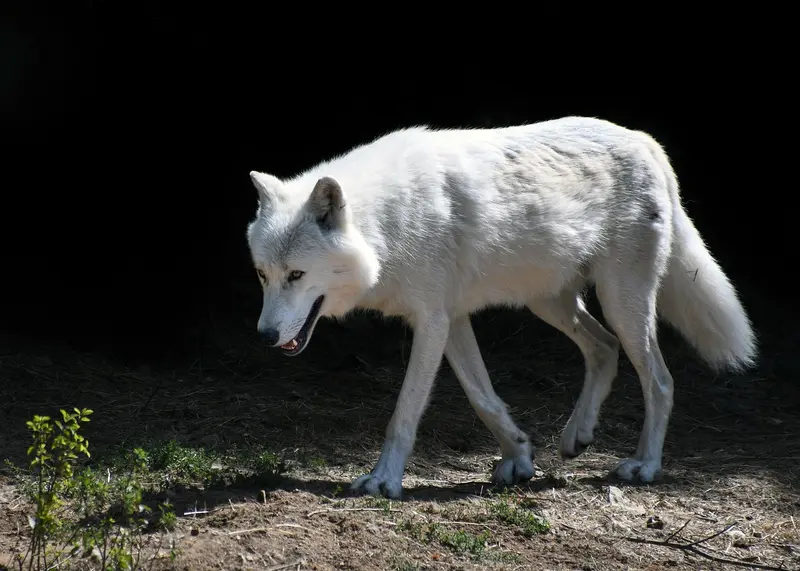
Good morning, everyone. In April 2025, a company called Colossal Biosciences announced that it had brought back the dire wolf, an animal that disappeared more than ten thousand years ago. The photos of white wolf pups went viral. But should we really bring back extinct animals? Today, I'll look at both sides of this question. First, I'll explain what the company actually did. Then I'll give two reasons for de-extinction and two reasons against it. Finally, I'll give my own conclusion, which is a "yes, but only under certain conditions."
Your recording
Say this slide out loud, then listen to yourself.
Recordings stay on this device and disappear when you leave the page.
Useful phrases
announced that it had
Told the public that it did something.
I'll look at both sides of this question
I'll explain the arguments for and against.
only under certain conditions
Only if some rules are followed.
Words
- dire wolf
- went viral
- extinct
- de-extinction
- gray wolf
- gene editing
- DNA
- black-footed ferret
- endangered
- genetic variety
- cloned
- clone
- conservation groups
- in the wild
- opportunity cost
- net loss
- undone
Highlighted words are on this slide. Tap a word to look it up on Google.
Full script
Read the whole talk.
All slides in one place. Read it through once, then practice slide by slide.
01The Return of the Dire Wolf?
Good morning, everyone. In April 2025, a company called Colossal Biosciences announced that it had brought back the dire wolf, an animal that disappeared more than ten thousand years ago. The photos of white wolf pups went viral. But should we really bring back extinct animals? Today, I'll look at both sides of this question. First, I'll explain what the company actually did. Then I'll give two reasons for de-extinction and two reasons against it. Finally, I'll give my own conclusion, which is a "yes, but only under certain conditions."
Buenos días a todos. En abril de 2025, una empresa llamada Colossal Biosciences anunció que había traído de vuelta al lobo terrible, un animal que desapareció hace más de diez mil años. Las fotos de los cachorros de lobo blancos se hicieron virales. Pero ¿de verdad deberíamos traer de vuelta a los animales extintos? Hoy voy a analizar los dos lados de esta pregunta. Primero, explicaré lo que la empresa hizo realmente. Luego daré dos razones a favor de la desextinción y dos razones en contra. Por último, daré mi propia conclusión, que es un «sí, pero solo bajo ciertas condiciones».
Sources: Colossal Biosciences, "The Return of the Dire Wolf" (April 7, 2025): announcement of three dire wolf pups; NPR, "A biotech company says it has bred three pups with traits of the extinct dire wolf" (April 8, 2025)
02What Did the Company Actually Do?
So, what did the company actually do? It didn't find a living dire wolf, and it didn't build one from nothing. Instead, scientists took cells from a gray wolf, a living species, and made 20 changes in 14 of its genes. They used gene editing, a tool that lets scientists change small parts of DNA. Three pups were born, two in October 2024 and one in January 2025. However, many scientists disagreed with the word "dire wolf." They said these are gray wolves with a few changes. In my view, this argument matters, because the name shapes how people see the whole project.
Entonces, ¿qué hizo realmente la empresa? No encontró un lobo terrible vivo ni lo construyó desde cero. En cambio, los científicos tomaron células de un lobo gris, una especie viva, e hicieron 20 cambios en 14 de sus genes. Usaron la edición genética, una herramienta que permite a los científicos cambiar pequeñas partes del ADN. Nacieron tres cachorros: dos en octubre de 2024 y uno en enero de 2025. Sin embargo, muchos científicos no estuvieron de acuerdo con el nombre «lobo terrible». Dijeron que son lobos grises con algunos cambios. En mi opinión, este debate importa, porque el nombre influye en cómo la gente ve todo el proyecto.
Sources: NPR, "A biotech company says it has bred three pups with traits of the extinct dire wolf" (April 8, 2025): the pups were made by editing gray wolf cells; two were born in October 2024 and one in January 2025; Scientific American, "This Company Claimed to 'De-extinct' Dire Wolves. Then the Fighting Started" (2025): 20 edits in 14 genes; many scientists argued the animals are gray wolves with a small number of changes
03For 1: The Tools Can Save Living Species
Let's start with the arguments for. My first reason is that the same tools can help animals that are still alive. A good example is the black-footed ferret, an endangered animal in North America. All of today's ferrets come from a very small group, so they have little genetic variety. In 2020, scientists cloned a ferret called Elizabeth Ann from cells that had been frozen since 1988. Then, in 2024, the U.S. Fish and Wildlife Service announced that another clone, Antonia, had given birth. This shows that these tools can bring lost genes back into a species that badly needs them.
Empecemos con los argumentos a favor. Mi primera razón es que las mismas herramientas pueden ayudar a animales que todavía están vivos. Un buen ejemplo es el hurón de patas negras, un animal en peligro de extinción en América del Norte. Todos los hurones actuales vienen de un grupo muy pequeño, así que tienen poca variedad genética. En 2020, los científicos clonaron a una hurona llamada Elizabeth Ann a partir de células congeladas desde 1988. Luego, en 2024, el Servicio de Pesca y Vida Silvestre de Estados Unidos anunció que otra clon, Antonia, había tenido crías. Esto muestra que estas herramientas pueden devolver genes perdidos a una especie que los necesita urgentemente.
Sources: U.S. Fish and Wildlife Service, "Innovative genetic research boosts black-footed ferret conservation efforts" (February 2021): Elizabeth Ann, born in December 2020, was cloned from cells of a ferret named Willa that were preserved in 1988; the species descends from a very small founding population with low genetic diversity; U.S. Fish and Wildlife Service, "Advancements in black-footed ferret conservation continue with new offspring from cloned ferret" (November 2024): Antonia, cloned from Willa's 1988 tissue samples, gave birth; the first time a cloned U.S. endangered species has produced offspring
04For 2: It Gets People Interested
My second reason for is about attention. When the dire wolf news came out, my friends who never talk about nature were sharing the photos and asking questions. One friend asked me why the dire wolf disappeared in the first place. That's exactly the kind of question conservation groups want people to ask. In my view, exciting projects like this can be a door into bigger topics, such as why animals go extinct and how we can protect the ones we still have. Of course, this is my own experience, not a study. But attention is often the first step toward support.
Mi segunda razón a favor tiene que ver con la atención. Cuando salió la noticia del lobo terrible, amigos míos que nunca hablan de la naturaleza compartían las fotos y hacían preguntas. Un amigo me preguntó por qué había desaparecido el lobo terrible en primer lugar. Ese es exactamente el tipo de pregunta que los grupos de conservación quieren que la gente se haga. En mi opinión, proyectos emocionantes como este pueden ser una puerta hacia temas más grandes, como por qué se extinguen los animales y cómo podemos proteger los que todavía tenemos. Claro, esta es mi propia experiencia, no un estudio. Pero la atención suele ser el primer paso hacia el apoyo.
05Against 1: Money Could Save More Species
Now, let's look at the arguments against. The strongest one, in my view, is about money. In 2017, Joseph Bennett and his team published a study in Nature Ecology and Evolution. They estimated the cost of protecting brought-back species in the wild. In New South Wales in Australia, the money needed for five brought-back species could instead protect 42 living species, more than eight times as many. Economists call this opportunity cost: when you spend money on one thing, you lose the chance to spend it on something else. So de-extinction could actually lead to a net loss of nature.
Ahora veamos los argumentos en contra. El más fuerte, en mi opinión, tiene que ver con el dinero. En 2017, Joseph Bennett y su equipo publicaron un estudio en Nature Ecology and Evolution. Estimaron el costo de proteger en la naturaleza a las especies traídas de vuelta. En Nueva Gales del Sur, en Australia, el dinero necesario para cinco especies traídas de vuelta podría proteger en cambio a 42 especies vivas, más de ocho veces más. Los economistas llaman a esto costo de oportunidad: cuando gastas dinero en una cosa, pierdes la oportunidad de gastarlo en otra. Así que la desextinción podría causar en realidad una pérdida neta de naturaleza.
Source: Bennett, J. R., et al. (2017). "Spending limited resources on de-extinction could lead to net biodiversity loss." Nature Ecology & Evolution, 1, 0053: in New South Wales, government funding for the conservation of five resurrected species could instead be used to conserve 42 extant species, more than eight times as many
06Against 2: Their World Is Gone
My second reason against is that the world these animals lived in is gone. The dire wolf lived in a time with very different animals and landscapes. Today, there is no place where a pack of these wolves could live freely. So, for now, the pups live in a fenced area owned by the company. This raises a hard question. If we bring an animal back but it can never live in the wild, who is it really for? Some people say it's mostly for science and for the company's image. That criticism seems fair to me, especially for animals that have been gone for thousands of years.
Mi segunda razón en contra es que el mundo en el que vivían estos animales ya no existe. El lobo terrible vivió en una época con animales y paisajes muy diferentes. Hoy no hay ningún lugar donde una manada de estos lobos pueda vivir libremente. Por eso, por ahora, los cachorros viven en una zona cercada que pertenece a la empresa. Esto plantea una pregunta difícil. Si traemos de vuelta a un animal pero nunca puede vivir en libertad, ¿para quién es realmente? Algunas personas dicen que es sobre todo para la ciencia y para la imagen de la empresa. Esa crítica me parece justa, sobre todo en el caso de animales que desaparecieron hace miles de años.
Source: Colossal Biosciences, "The Return of the Dire Wolf" (April 2025): dire wolves went extinct more than 10,000 years ago; the pups live on a 2,000+ acre secure preserve at an undisclosed location, surrounded by high fencing
07My Conclusion: Yes, With Conditions
So, where do I stand? My answer is yes, but with three conditions. First, the main goal should be helping living species, like the black-footed ferret, not bringing back animals whose world is gone. Second, public conservation money shouldn't pay for it, because Bennett's study shows that the same money could protect many more living species. Private companies can pay for their own projects. Third, companies should use honest names. Calling a changed gray wolf a dire wolf gets attention, but it can make people think extinction can be undone. And it can't.
Entonces, ¿cuál es mi postura? Mi respuesta es sí, pero con tres condiciones. Primero, el objetivo principal debería ser ayudar a especies vivas, como el hurón de patas negras, no traer de vuelta animales cuyo mundo ya no existe. Segundo, el dinero público para la conservación no debería pagarlo, porque el estudio de Bennett muestra que el mismo dinero podría proteger muchas más especies vivas. Las empresas privadas pueden pagar sus propios proyectos. Tercero, las empresas deberían usar nombres honestos. Llamar lobo terrible a un lobo gris modificado atrae atención, pero puede hacer creer a la gente que la extinción se puede deshacer. Y no se puede.
08Protect What We Still Have
To sum up, de-extinction has real benefits. The tools can help living species, and the news gets people interested in nature. But it also has serious costs: the money could protect more living species, and the world of many extinct animals is gone. That's why my answer is yes, but only with conditions. In the end, the best way to deal with extinction is to stop it from happening in the first place. Thank you for listening. I'm happy to take your questions.
En resumen, la desextinción tiene beneficios reales. Las herramientas pueden ayudar a especies vivas, y la noticia despierta el interés de la gente por la naturaleza. Pero también tiene costos serios: el dinero podría proteger más especies vivas, y el mundo de muchos animales extintos ya no existe. Por eso mi respuesta es sí, pero solo con condiciones. Al final, la mejor manera de enfrentar la extinción es evitar que ocurra en primer lugar. Gracias por su atención. Con gusto responderé a sus preguntas.
More Environment & Nature presentations



Cover photo by christels on Pixabay