英语演讲的示范讲稿与中文翻译。每一页都可以听示范、开口练习。
Are We Alone?
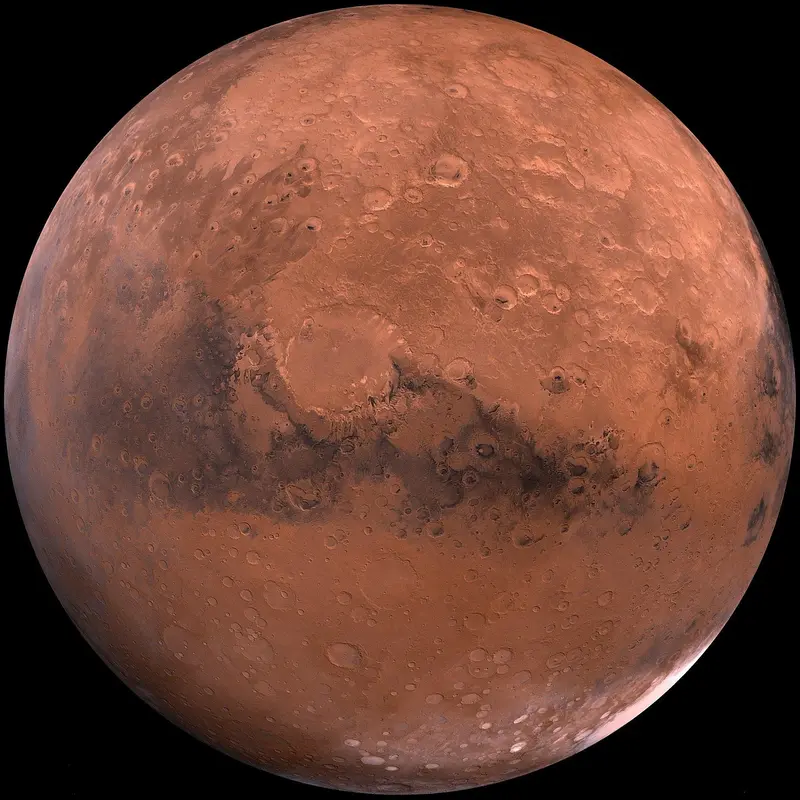
Mars: a rock with strange spots
1 / 8
Model script
Good afternoon, everyone. Are we alone in the universe? For most of history, this was a question for philosophers. Now, for the first time, we have real tools that can look for an answer. Today, I'll make a prediction: will we find signs of life beyond Earth by 2050? To answer, I'll look at three places. First, Mars, where a rover found a very interesting rock. Next, Europa, a moon of Jupiter with an ocean under its ice. Then, distant planets around other stars. Finally, I'll give my prediction and explain why I'm careful about it.
Your recording
Say this slide out loud, then listen to yourself.
Recordings stay on this device and disappear when you leave the page.
Useful phrases
for the first time
This has never happened before.
I'll make a prediction
I'll say what I think will happen in the future.
explain why I'm careful about it
Say why I don't want to be too sure.
Words
- philosophers
- rover
- biosignature
- astronomy
- crater
- riverbed
- minerals
- microbes
- ruled out
- icy surface
- spacecraft
- life-detection mission
- space telescope
- made headlines
Highlighted words are on this slide. Tap a word to look it up on Google.
Full script
Read the whole talk.
All slides in one place. Read it through once, then practice slide by slide.
01Are We Alone?
Good afternoon, everyone. Are we alone in the universe? For most of history, this was a question for philosophers. Now, for the first time, we have real tools that can look for an answer. Today, I'll make a prediction: will we find signs of life beyond Earth by 2050? To answer, I'll look at three places. First, Mars, where a rover found a very interesting rock. Next, Europa, a moon of Jupiter with an ocean under its ice. Then, distant planets around other stars. Finally, I'll give my prediction and explain why I'm careful about it.
大家下午好。宇宙中只有我们吗?在人类历史的大部分时间里,这是哲学家思考的问题。而现在,我们第一次拥有了能够寻找答案的真正工具。今天我要做一个预测:到2050年,我们会在地球以外找到生命的迹象吗?为了回答这个问题,我会看三个地方。首先是火星,一辆探测车在那里发现了一块非常有意思的岩石。接着是木卫二,也就是木星的一颗卫星,它的冰层下面有海洋。然后是围绕其他恒星运行的遥远行星。最后,我会给出我的预测,并解释我为什么对它持谨慎态度。
02Key Term: A Biosignature
Before we start, I need to explain one key term: biosignature. A biosignature is a clue that life may have made something, such as a chemical or a pattern in a rock. The important word is "may." A biosignature is not proof, because many clues can also be made without life. I first learned this in an astronomy class in my first year. My professor showed us a news headline that said scientists had found life, and then she asked us one question: "What else could explain this?" I'll ask that same question for each example today.
开始之前,我需要解释一个关键术语:生物标志。生物标志是一种线索,表明某样东西可能是生命产生的,比如一种化学物质,或者岩石上的某种图案。关键在于“可能”这两个字。生物标志不是证据,因为很多线索在没有生命的情况下也可能形成。我第一次学到这一点,是在大一的天文学课上。老师给我们看了一条新闻标题,说科学家发现了生命,然后她只问了我们一个问题:“还有什么能解释这个现象?”今天,我会对每个例子都问同样的问题。
03Mars: The Leopard Spots
My first place is Mars. In July 2024, NASA's Perseverance rover drilled a sample from a rock nicknamed "Cheyava Falls" in Jezero Crater, an area that was once an ancient riverbed. The rock has small marks that scientists call "leopard spots." In September 2025, a team led by Joel Hurowitz published a study in the journal Nature. They described the sample as a potential biosignature, because on Earth, minerals like these can form when microbes are involved. NASA said it was one of the clearest signs of possible ancient life it had found.
第一个地方是火星。2024年7月,美国宇航局的“毅力号”探测车在耶泽罗陨石坑里,从一块绰号为“切亚瓦瀑布”的岩石上钻取了样本。这片区域曾经是一条古老的河床。这块岩石上有一些小斑点,科学家称之为“豹纹斑点”。2025年9月,乔尔·胡罗维茨带领的团队在《自然》杂志上发表了研究。他们把这份样本描述为“潜在的生物标志”,因为在地球上,这类矿物可能是在微生物参与下形成的。美国宇航局表示,这是他们迄今发现的、可能存在古代生命的最明确迹象之一。
Sources: Hurowitz, J. A., et al. (2025). "Redox-driven mineral and organic associations in Jezero Crater, Mars." Nature, published 10 September 2025: the Sapphire Canyon sample was drilled from the rock "Cheyava Falls" in July 2024 in Jezero Crater's ancient river valley; its "leopard spots" were described as a potential biosignature; NASA, "NASA Says Mars Rover Discovered Potential Biosignature Last Year" (September 10, 2025): NASA described the sample as its clearest sign yet of possible ancient life on Mars
04What Else Could Explain It?
So, have we found life on Mars? Not yet. Let's ask my professor's question: what else could explain it? The researchers themselves said that non-living chemistry could not be fully ruled out. In other words, the spots might have formed without any microbes at all. There's also a practical problem. Perseverance's instruments are small, and the sample is still sitting on Mars. In my view, scientists will only be confident after they study pieces of this rock in large laboratories on Earth. So Mars gives us a strong clue, but it doesn't give us an answer yet.
那么,我们在火星上找到生命了吗?还没有。我们来问问老师的那个问题:还有什么能解释这个现象?研究人员自己也说,不能完全排除非生物化学反应的可能。换句话说,这些斑点也许在完全没有微生物的情况下就形成了。此外还有一个现实问题。“毅力号”上的仪器很小,而样本现在还留在火星上。在我看来,只有在地球上的大型实验室里研究了这块岩石的碎片之后,科学家才能有把握。所以,火星给了我们一条有力的线索,但还没有给出答案。
Source: Hurowitz, J. A., et al. (2025). Nature: the authors state that abiotic (non-biological) processes cannot be fully excluded and that further study is needed; the sample remains in a sealed tube carried by Perseverance on Mars
05Europa: An Ocean Under the Ice
My second place is Europa, one of Jupiter's moons. Scientists believe it has a huge ocean of salty water under its icy surface. On October 14, 2024, NASA launched a spacecraft called Europa Clipper. It's planned to reach Jupiter in 2030 and then fly past Europa again and again. But here's an important detail. According to NASA, Europa Clipper is not a life-detection mission. Its job is to find out whether Europa has the conditions that could support life. So even if everything goes well, Europa Clipper will tell us where to look next, not whether anything lives there.
第二个地方是木卫二,它是木星的卫星之一。科学家认为,在它冰冷的表面下,有一片巨大的咸水海洋。2024年10月14日,美国宇航局发射了一艘名为“欧罗巴快船”的探测器。按计划,它将在2030年抵达木星,然后一次又一次地飞掠木卫二。但这里有一个重要的细节。根据美国宇航局的说法,“欧罗巴快船”并不是一项寻找生命的任务。它的任务是查明木卫二是否具备支持生命存在的条件。所以,即使一切顺利,“欧罗巴快船”告诉我们的也是下一步该去哪里找,而不是那里有没有生命。
Source: NASA Science, "Europa Clipper" mission page: launched October 14, 2024; arrival at Jupiter in 2030; the mission's goal is to determine whether Europa has conditions suitable for life, and it is not a life-detection mission
06Distant Planets: A Claim That Fell Apart
My third place is much farther away. In 2025, a team led by Nikku Madhusudhan used the James Webb Space Telescope to study a planet called K2-18b. They reported a possible sign of a gas that, on Earth, is mostly made by living things. It made headlines around the world. However, other teams looked at all of the telescope data again. A study led by Rafael Luque, published in Astronomy and Astrophysics in 2025, found no strong evidence for the gas. To me, this is the best example of why we should wait before getting excited.
第三个地方要遥远得多。2025年,尼库·马杜苏丹带领的团队用詹姆斯·韦布空间望远镜研究了一颗名为K2-18b的行星。他们报告说,可能发现了一种气体的迹象,而在地球上,这种气体主要是由生物产生的。这个消息登上了世界各地的新闻头条。然而,其他团队重新分析了望远镜的全部数据。由拉斐尔·卢克带领、2025年发表在《天文学与天体物理学》期刊上的研究,并没有找到这种气体的有力证据。对我来说,这是最能说明“兴奋之前要先等等”的例子。
Sources: Madhusudhan, N., et al. (2025). "New Constraints on DMS and DMDS in the Atmosphere of K2-18 b from JWST MIRI." The Astrophysical Journal Letters, 983, L40: reported features consistent with dimethyl sulfide (DMS) and/or dimethyl disulfide (DMDS), which on Earth are produced mainly by life; Luque, R., et al. (2025). "Insufficient evidence for DMS and DMDS in the atmosphere of K2-18 b." Astronomy & Astrophysics: a joint analysis of all JWST observations found no statistically significant evidence for DMS or DMDS
07My Prediction for 2050
So, here's my prediction. I think that by 2050, we will probably have strong signs that simple life existed on ancient Mars. I think this because the Mars sample already exists, and scientists only need to study it properly. However, I don't think we'll have proof of anything alive today, on Europa or on distant planets. Some people say this search is a waste of money if the answer is so uncertain. That's a fair point. But even a "no" teaches us something: it tells us how rare life might be. In my view, that's worth knowing.
那么,我的预测是这样的。我认为,到2050年,我们很可能会掌握有力的迹象,证明古代火星上曾经存在过简单的生命。我这样认为,是因为火星样本已经有了,科学家只需要好好研究它。不过,我不认为我们能证明今天有任何活着的生命,无论是在木卫二还是在遥远的行星上。有人说,既然答案这么不确定,这种探索就是浪费钱。这个观点有道理。但即使答案是“没有”,也能告诉我们一些东西:它让我们知道生命可能有多么罕见。在我看来,这是值得知道的。
08Clues, Not Answers, for Now
To sum up, Mars has given us the strongest clue so far, but the rock still needs to be studied on Earth. Europa Clipper will tell us whether Europa could support life, not whether it does. And the story of K2-18b reminds us to ask, "What else could explain this?" So my answer to today's question is a careful one: by 2050, we'll probably have strong signs of ancient life, but not final proof. Thank you for listening. I'm happy to take your questions.
总结一下,火星给了我们迄今为止最有力的线索,但那块岩石还需要在地球上进行研究。“欧罗巴快船”会告诉我们木卫二是否能够支持生命,而不是那里是否真的有生命。K2-18b的故事则提醒我们,要问一句:“还有什么能解释这个现象?”所以,我对今天这个问题的回答是谨慎的:到2050年,我们很可能会找到古代生命的有力迹象,但还不会有最终的证据。谢谢大家的聆听。欢迎大家提问。
More Science & Technology presentations




Cover photo by WikiImages on Pixabay