英語プレゼンのお手本の原稿と日本語訳。スライドごとに、聞いて・話して練習できます。
Are We Alone?
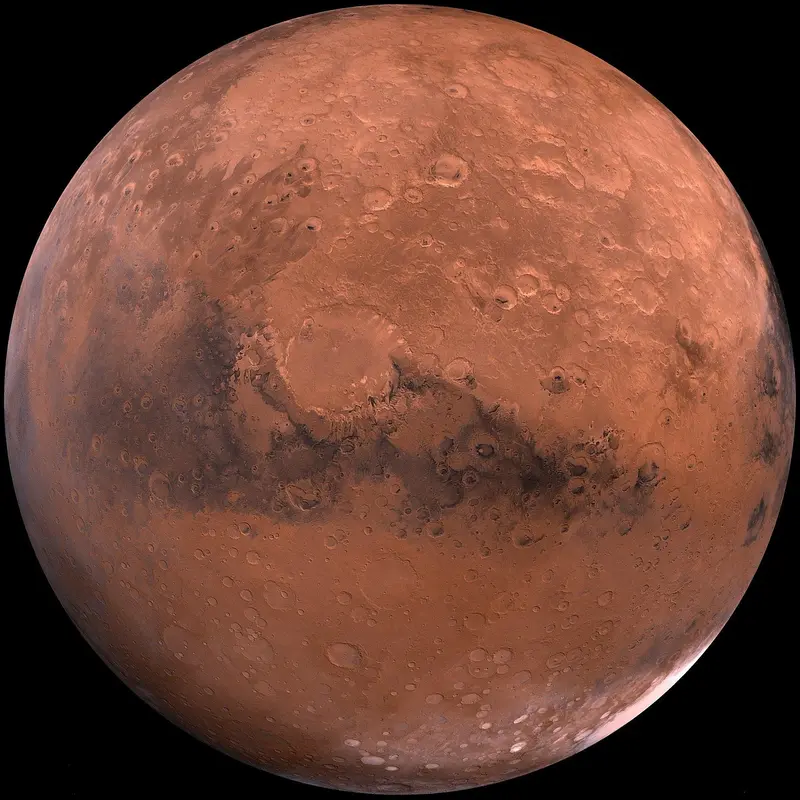
Mars: a rock with strange spots
1 / 8
Model script
Good afternoon, everyone. Are we alone in the universe? For most of history, this was a question for philosophers. Now, for the first time, we have real tools that can look for an answer. Today, I'll make a prediction: will we find signs of life beyond Earth by 2050? To answer, I'll look at three places. First, Mars, where a rover found a very interesting rock. Next, Europa, a moon of Jupiter with an ocean under its ice. Then, distant planets around other stars. Finally, I'll give my prediction and explain why I'm careful about it.
Your recording
Say this slide out loud, then listen to yourself.
Recordings stay on this device and disappear when you leave the page.
Useful phrases
for the first time
This has never happened before.
I'll make a prediction
I'll say what I think will happen in the future.
explain why I'm careful about it
Say why I don't want to be too sure.
Words
- philosophers
- rover
- biosignature
- astronomy
- crater
- riverbed
- minerals
- microbes
- ruled out
- icy surface
- spacecraft
- life-detection mission
- space telescope
- made headlines
Highlighted words are on this slide. Tap a word to look it up on Google.
Full script
Read the whole talk.
All slides in one place. Read it through once, then practice slide by slide.
01Are We Alone?
Good afternoon, everyone. Are we alone in the universe? For most of history, this was a question for philosophers. Now, for the first time, we have real tools that can look for an answer. Today, I'll make a prediction: will we find signs of life beyond Earth by 2050? To answer, I'll look at three places. First, Mars, where a rover found a very interesting rock. Next, Europa, a moon of Jupiter with an ocean under its ice. Then, distant planets around other stars. Finally, I'll give my prediction and explain why I'm careful about it.
みなさん、こんにちは。宇宙にいるのは私たちだけなのでしょうか。歴史のほとんどの間、これは哲学者が考える問いでした。でも今、私たちは初めて、答えを探せる本物の道具を持っています。今日は、ある予測をします。2050年までに、地球の外で生命のしるしは見つかるのでしょうか。答えるために、3つの場所を見ていきます。まず火星です。探査車がとても興味深い岩を見つけました。次に、木星の衛星エウロパです。氷の下に海があります。それから、ほかの恒星のまわりを回る遠い惑星です。最後に、私の予測をお話しし、なぜ慎重に考えているのかを説明します。
02Key Term: A Biosignature
Before we start, I need to explain one key term: biosignature. A biosignature is a clue that life may have made something, such as a chemical or a pattern in a rock. The important word is "may." A biosignature is not proof, because many clues can also be made without life. I first learned this in an astronomy class in my first year. My professor showed us a news headline that said scientists had found life, and then she asked us one question: "What else could explain this?" I'll ask that same question for each example today.
始める前に、1つの大切な用語を説明します。「バイオシグネチャー」です。バイオシグネチャーとは、化学物質や岩の模様など、生き物が作ったかもしれないものの手がかりのことです。大事なのは「かもしれない」という言葉です。バイオシグネチャーは証拠ではありません。多くの手がかりは、生き物がいなくてもできることがあるからです。私がこれを初めて学んだのは、1年生の天文学の授業でした。先生は「科学者が生命を発見した」というニュースの見出しを見せてから、1つだけ質問しました。「ほかに、これを説明できるものはありますか?」今日は、それぞれの例で、同じ質問をしていきます。
03Mars: The Leopard Spots
My first place is Mars. In July 2024, NASA's Perseverance rover drilled a sample from a rock nicknamed "Cheyava Falls" in Jezero Crater, an area that was once an ancient riverbed. The rock has small marks that scientists call "leopard spots." In September 2025, a team led by Joel Hurowitz published a study in the journal Nature. They described the sample as a potential biosignature, because on Earth, minerals like these can form when microbes are involved. NASA said it was one of the clearest signs of possible ancient life it had found.
1つ目の場所は火星です。2024年7月、NASAの探査車パーサヴィアランスは、ジェゼロ・クレーターにある「シャイアバ・フォールズ」というあだ名の岩から、サンプルを掘り取りました。この場所は、昔は川底だったところです。岩には、科学者が「ヒョウ柄の斑点」と呼ぶ小さな模様があります。2025年9月、ジョエル・ハーウィッツが率いるチームは、学術誌「ネイチャー」に研究を発表しました。地球では、このような鉱物は微生物が関わってできることがあるので、チームはこのサンプルを「バイオシグネチャーの可能性があるもの」と説明しました。NASAは、これまでに見つけた古代の生命の可能性を示すしるしの中で、最もはっきりしたものの1つだと述べました。
Sources: Hurowitz, J. A., et al. (2025). "Redox-driven mineral and organic associations in Jezero Crater, Mars." Nature, published 10 September 2025: the Sapphire Canyon sample was drilled from the rock "Cheyava Falls" in July 2024 in Jezero Crater's ancient river valley; its "leopard spots" were described as a potential biosignature; NASA, "NASA Says Mars Rover Discovered Potential Biosignature Last Year" (September 10, 2025): NASA described the sample as its clearest sign yet of possible ancient life on Mars
04What Else Could Explain It?
So, have we found life on Mars? Not yet. Let's ask my professor's question: what else could explain it? The researchers themselves said that non-living chemistry could not be fully ruled out. In other words, the spots might have formed without any microbes at all. There's also a practical problem. Perseverance's instruments are small, and the sample is still sitting on Mars. In my view, scientists will only be confident after they study pieces of this rock in large laboratories on Earth. So Mars gives us a strong clue, but it doesn't give us an answer yet.
では、火星で生命は見つかったのでしょうか。まだです。先生の質問をしてみましょう。ほかに、これを説明できるものはあるでしょうか。研究者たち自身が、生き物によらない化学反応の可能性を完全には否定できないと言っています。つまり、斑点は微生物がまったくいなくてもできたのかもしれません。現実的な問題もあります。パーサヴィアランスの装置は小さく、サンプルはまだ火星に置かれたままです。私の考えでは、科学者が自信を持てるのは、この岩のかけらを地球の大きな研究室で調べたあとです。つまり火星は、強い手がかりはくれますが、まだ答えはくれないのです。
Source: Hurowitz, J. A., et al. (2025). Nature: the authors state that abiotic (non-biological) processes cannot be fully excluded and that further study is needed; the sample remains in a sealed tube carried by Perseverance on Mars
05Europa: An Ocean Under the Ice
My second place is Europa, one of Jupiter's moons. Scientists believe it has a huge ocean of salty water under its icy surface. On October 14, 2024, NASA launched a spacecraft called Europa Clipper. It's planned to reach Jupiter in 2030 and then fly past Europa again and again. But here's an important detail. According to NASA, Europa Clipper is not a life-detection mission. Its job is to find out whether Europa has the conditions that could support life. So even if everything goes well, Europa Clipper will tell us where to look next, not whether anything lives there.
2つ目の場所は、木星の衛星の1つ、エウロパです。科学者たちは、エウロパの氷の表面の下に、塩分を含む水の巨大な海があると考えています。2024年10月14日、NASAは「エウロパ・クリッパー」という探査機を打ち上げました。2030年に木星に着き、そのあとエウロパのそばを何度も通る予定です。でも、ここに大事な点があります。NASAによると、エウロパ・クリッパーは生命を見つけるための探査ではありません。その仕事は、エウロパに生命を支えられる条件があるかどうかを調べることです。つまり、すべてがうまくいっても、エウロパ・クリッパーが教えてくれるのは「次にどこを探せばよいか」であって、「そこに何かが生きているか」ではないのです。
Source: NASA Science, "Europa Clipper" mission page: launched October 14, 2024; arrival at Jupiter in 2030; the mission's goal is to determine whether Europa has conditions suitable for life, and it is not a life-detection mission
06Distant Planets: A Claim That Fell Apart
My third place is much farther away. In 2025, a team led by Nikku Madhusudhan used the James Webb Space Telescope to study a planet called K2-18b. They reported a possible sign of a gas that, on Earth, is mostly made by living things. It made headlines around the world. However, other teams looked at all of the telescope data again. A study led by Rafael Luque, published in Astronomy and Astrophysics in 2025, found no strong evidence for the gas. To me, this is the best example of why we should wait before getting excited.
3つ目の場所は、ずっと遠くにあります。2025年、ニック・マドゥスダンが率いるチームは、ジェームズ・ウェッブ宇宙望遠鏡を使って、「K2-18b」という惑星を調べました。チームは、地球ではほとんどが生き物によって作られる気体の、可能性のあるしるしを報告しました。このニュースは世界中で大きく報じられました。ところが、ほかのチームが望遠鏡のデータをすべて見直しました。ラファエル・ルケが率いて、2025年に学術誌「アストロノミー・アンド・アストロフィジックス」に発表された研究では、その気体の強い証拠は見つかりませんでした。私にとって、これは、喜ぶ前に待つべき理由を示すいちばんよい例です。
Sources: Madhusudhan, N., et al. (2025). "New Constraints on DMS and DMDS in the Atmosphere of K2-18 b from JWST MIRI." The Astrophysical Journal Letters, 983, L40: reported features consistent with dimethyl sulfide (DMS) and/or dimethyl disulfide (DMDS), which on Earth are produced mainly by life; Luque, R., et al. (2025). "Insufficient evidence for DMS and DMDS in the atmosphere of K2-18 b." Astronomy & Astrophysics: a joint analysis of all JWST observations found no statistically significant evidence for DMS or DMDS
07My Prediction for 2050
So, here's my prediction. I think that by 2050, we will probably have strong signs that simple life existed on ancient Mars. I think this because the Mars sample already exists, and scientists only need to study it properly. However, I don't think we'll have proof of anything alive today, on Europa or on distant planets. Some people say this search is a waste of money if the answer is so uncertain. That's a fair point. But even a "no" teaches us something: it tells us how rare life might be. In my view, that's worth knowing.
では、私の予測です。2050年までに、昔の火星に単純な生き物がいたという強いしるしが、おそらく手に入ると思います。そう考える理由は、火星のサンプルはもうあって、科学者はそれをきちんと調べさえすればよいからです。ただし、エウロパでも遠い惑星でも、今生きている何かの証拠までは手に入らないと思います。答えがこれほど不確かなら、この探索はお金のむだだと言う人もいます。もっともな意見です。でも、「いなかった」という答えでさえ、私たちに何かを教えてくれます。生命がどれほど珍しいものかもしれないか、ということです。私の考えでは、それは知る価値があることです。
08Clues, Not Answers, for Now
To sum up, Mars has given us the strongest clue so far, but the rock still needs to be studied on Earth. Europa Clipper will tell us whether Europa could support life, not whether it does. And the story of K2-18b reminds us to ask, "What else could explain this?" So my answer to today's question is a careful one: by 2050, we'll probably have strong signs of ancient life, but not final proof. Thank you for listening. I'm happy to take your questions.
まとめると、火星はこれまでで最も強い手がかりをくれましたが、その岩はまだ地球で調べる必要があります。エウロパ・クリッパーが教えてくれるのは、エウロパが生命を支えられるかどうかであって、実際に生命がいるかどうかではありません。そしてK2-18bの話は、「ほかに、これを説明できるものはあるか」と問うことを思い出させてくれます。ですから、今日の問いへの私の答えは慎重なものです。2050年までに、昔の生命の強いしるしはおそらく見つかりますが、最終的な証拠までは見つからないでしょう。ご清聴ありがとうございました。ご質問があれば、喜んでお答えします。
More Science & Technology presentations




Cover photo by WikiImages on Pixabay