英語プレゼンのお手本の原稿と日本語訳。スライドごとに、聞いて・話して練習できます。
Is Space Worth the Money?
The cost
1 / 8
Model script
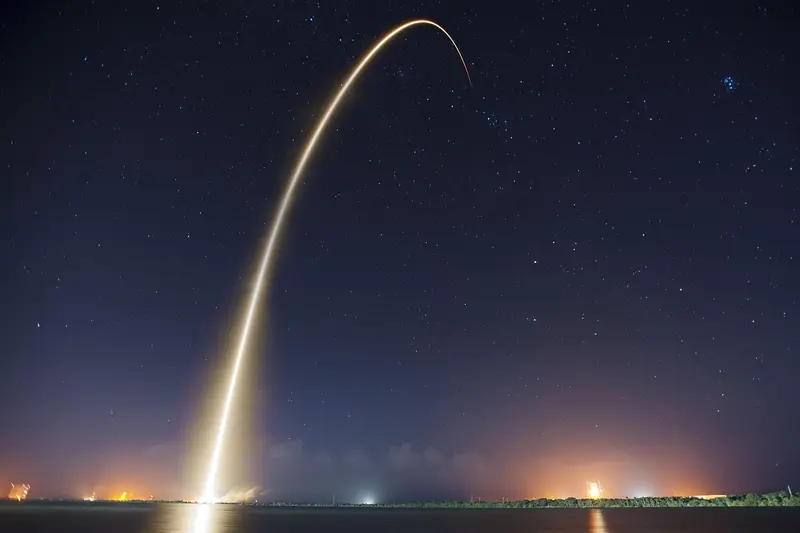
Good morning, everyone. Last year, I watched a rocket launch online, live, with millions of other people. It was exciting. But afterwards, my friend asked me a hard question: "Why spend so much money on space when we have so many problems on Earth?" Today, I'll try to answer that question fairly. First, I'll look at how much space really costs. Then, I'll give two arguments for space and the strongest argument against it. Finally, I'll give my conclusion.
Your recording
Say this slide out loud, then listen to yourself.
Recordings stay on this device and disappear when you leave the page.
Useful phrases
asked me a hard question
Asked something difficult to answer.
answer that question fairly
Reply in a balanced way, looking at both sides.
Finally, I'll give my conclusion
My last point will be my final opinion.
Words
Highlighted words are on this slide. Tap a word to look it up on Google.
Full script
Read the whole talk.
All slides in one place. Read it through once, then practice slide by slide.
01Is Space Worth the Money?
Good morning, everyone. Last year, I watched a rocket launch online, live, with millions of other people. It was exciting. But afterwards, my friend asked me a hard question: "Why spend so much money on space when we have so many problems on Earth?" Today, I'll try to answer that question fairly. First, I'll look at how much space really costs. Then, I'll give two arguments for space and the strongest argument against it. Finally, I'll give my conclusion.
みなさん、おはようございます。去年、私はロケットの打ち上げを、何百万人もの人と一緒にネットの生中継で見ました。わくわくしました。でもそのあと、友だちに難しい質問をされました。「地球にこんなにたくさん問題があるのに、どうして宇宙にそんなにお金を使うの?」今日は、この質問に公平に答えてみたいと思います。まず、宇宙開発に実際どれくらいお金がかかっているのかを見ます。次に、宇宙開発に賛成する理由を2つと、反対するいちばん強い理由を紹介します。最後に、私の結論をお伝えします。
02What Does It Cost?
Let's start with the numbers. According to The Planetary Society, NASA's budget for 2024 was about 24.9 billion dollars. That sounds huge, and it is. But USAFacts, a non-profit that studies government data, reports that NASA's spending was only about 0.4% of all U.S. federal spending that year. In other words, for every 100 dollars the U.S. government spent, NASA got about 40 cents. Of course, other countries spend money on space, too, but the U.S. budget is the easiest to check, so I'll use it as an example. So space is expensive, but it's a small part of the total.
まず数字から始めましょう。プラネタリー協会によると、2024年のNASAの予算は約249億ドルでした。ものすごい額に聞こえますし、実際にそうです。でも、政府のデータを調べている非営利団体のUSAFactsによると、NASAの支出は、その年のアメリカ連邦政府の支出全体のわずか約0.4%でした。言いかえると、アメリカ政府が100ドル使うごとに、NASAに回ったのは約40セントです。もちろん、ほかの国も宇宙にお金を使っていますが、アメリカの予算がいちばん確かめやすいので、例として使います。ですから、宇宙開発はお金がかかりますが、全体から見ればほんの一部なのです。
Sources: The Planetary Society, "NASA's FY 2024 Budget" ($24.875 billion); USAFacts, "National Aeronautics and Space Administration" (NASA spent $25 billion in FY 2024, 0.4% of the $6.78 trillion in federal spending)
03For: Inventions We Use Every Day
Now, the case for space. My first reason is that space research often brings benefits back to Earth. Here's one example from NASA itself. In 1966, NASA paid an engineer to design a safer airplane seat that could absorb shock. The result was a new kind of foam, first sold in 1969 as "temper foam." Today, we call it memory foam, and it's in pillows and mattresses around the world. I sleep on a memory foam pillow every night, and I had no idea it was connected to space. This shows that money spent on space can create things we use every day.
では、宇宙開発に賛成する側です。1つ目の理由は、宇宙の研究が地球に恩恵をもたらすことが多いからです。NASA自身が紹介している例を1つ挙げます。1966年、NASAはある技術者にお金を出して、衝撃を吸収できる、より安全な飛行機の座席を設計してもらいました。その結果生まれたのが新しい種類のウレタンで、1969年に「テンパーフォーム」として初めて売り出されました。今では低反発ウレタンと呼ばれ、世界中の枕やマットレスに使われています。私は毎晩、低反発の枕で寝ていますが、それが宇宙とつながっているとはまったく知りませんでした。このことから、宇宙に使われたお金が、私たちが毎日使うものを生み出せることが分かります。
Source: NASA Spinoff 2005, "Consumer, Home, and Recreation" (temper foam developed in 1966 under a NASA contract to improve airplane seat protection; commercialized in 1969)
04For: Satellites Guide Us
My second reason is that space technology is already part of our daily lives. Think about GPS. According to GPS.gov, the official U.S. government website, the United States is committed to keeping at least 24 GPS satellites working, 95% of the time. Every time you use a map app, order a delivery, or call for help and share your location, you're using satellites in space. In other words, space isn't far away. It's in your pocket.
2つ目の理由は、宇宙の技術がすでに私たちの毎日の暮らしの一部になっていることです。GPSを考えてみてください。アメリカ政府の公式サイトGPS.govによると、アメリカは少なくとも24機のGPS衛星を、95%の時間、動いている状態に保つと約束しています。地図アプリを使うとき、配達を頼むとき、助けを呼んで自分の位置を伝えるとき、私たちはいつも宇宙の衛星を使っているのです。言いかえると、宇宙は遠いところにあるのではありません。ポケットの中にあるのです。
Source: GPS.gov, "Space Segment" (the United States is committed to maintaining the availability of at least 24 operational GPS satellites, 95% of the time; operated by the U.S. Space Force)
05Against: Costs Keep Growing
However, there's a strong argument on the other side. Big space programs often cost far more than planned. In 2021, NASA's own Office of Inspector General, which checks how NASA uses its money, projected that NASA would spend 93 billion dollars on its Artemis Moon program from 2012 to 2025. It also said that NASA's estimates significantly understate the real cost. Critics ask a fair question: what could that money do for health, schools, or climate change here on Earth? When I read this report, I understood my friend's question much better.
しかし、反対側にも強い意見があります。大きな宇宙計画は、予定よりはるかにお金がかかることが多いのです。2021年、NASAのお金の使い方を調べるNASA自身の監察総監室は、2012年から2025年までに、NASAが月をめざすアルテミス計画に930億ドルを使うと見積もりました。さらに、NASAの見積もりは実際の費用をかなり少なく見せていると指摘しました。批判する人たちは、もっともな疑問を投げかけています。そのお金があれば、ここ地球で、健康や学校、気候変動のために何ができただろうか、と。この報告を読んで、友だちの質問の意味がずっとよく分かりました。
Source: NASA Office of Inspector General, "NASA's Management of the Artemis Missions" (IG-22-003, November 2021; projected $93 billion on Artemis from FY 2012 through FY 2025; estimates "significantly understate" the cost)
06Lost at Night
To be honest, I understand both sides, because of something that happened to me. Last year, I traveled abroad and got lost in a city late at night. My phone battery was low, and I didn't speak the language. But the map on my phone, using GPS, showed me exactly where I was and guided me back to my hotel. At that moment, I didn't think about budgets. I just felt thankful for those satellites. It made me realize that space technology is not only for astronauts.
正直に言うと、私は両方の考えが分かります。自分に起きたあることがきっかけです。去年、海外旅行をしたとき、夜遅くに知らない街で道に迷いました。スマートフォンの電池は少なく、その国の言葉も話せませんでした。でも、GPSを使うスマートフォンの地図が、私がどこにいるのかを正確に示し、ホテルまで案内してくれました。そのときは、予算のことなど考えませんでした。ただ、あの衛星たちに感謝していました。宇宙の技術は宇宙飛行士だけのものではないと気づきました。
07Yes, With Conditions
So, is it worth it? In my view, yes, but with conditions. First, space programs should have honest budgets and clear goals from the start. Second, independent groups, like NASA's inspector general, should keep checking the costs, and governments should listen to them. And third, this is my own idea, but countries could share the costs by working together on big missions, so that no single country has to pay for everything. Without these conditions, I think my friend's criticism would be right.
では、お金に見合う価値はあるのでしょうか?私の考えでは、イエスです。ただし条件付きです。1つ目に、宇宙計画は最初から、正直な予算とはっきりした目標を持つべきです。2つ目に、NASAの監察総監のような独立した機関が費用をチェックし続け、政府はその意見に耳を傾けるべきです。そして3つ目に、これは私自身の考えですが、大きなミッションでは国どうしが協力して費用を分け合えば、1つの国がすべてを払わなくてすむはずです。こうした条件がなければ、友だちの批判のほうが正しいと思います。
08Worth It, If We Spend It Wisely
To sum up, space is a small part of government spending, about 40 cents of every 100 dollars in the U.S. It has given us real benefits, like memory foam and GPS. But big programs can cost far more than planned, so the costs must be watched closely. That's why my answer is yes, space exploration is worth the money, if we spend it wisely. Thank you for listening. I'm happy to take your questions.
まとめると、宇宙開発は政府の支出のほんの一部で、アメリカでは100ドルのうち約40セントです。低反発ウレタンやGPSのような、本当の恩恵ももたらしてきました。でも、大きな計画は予定よりはるかにお金がかかることがあるので、費用をしっかり見張る必要があります。だから私の答えはイエスです。賢く使うなら、宇宙開発はお金に見合う価値があります。ご清聴ありがとうございました。ご質問があればどうぞ。
Sources: USAFacts, "National Aeronautics and Space Administration" (0.4% of federal spending in FY 2024); NASA Spinoff 2005; GPS.gov, "Space Segment"; NASA Office of Inspector General, IG-22-003 (2021)
More Science & Technology presentations
Cover photo by SpaceX-Imagery on Pixabay