Guion modelo de una presentación en inglés con traducción al español. Escucha y practica diapositiva por diapositiva.
Is Space Worth the Money?
The cost
1 / 8
Model script
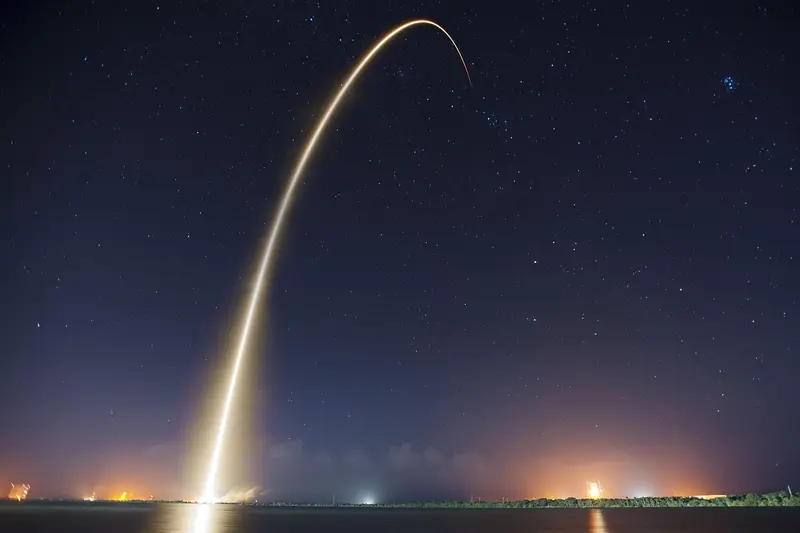
Good morning, everyone. Last year, I watched a rocket launch online, live, with millions of other people. It was exciting. But afterwards, my friend asked me a hard question: "Why spend so much money on space when we have so many problems on Earth?" Today, I'll try to answer that question fairly. First, I'll look at how much space really costs. Then, I'll give two arguments for space and the strongest argument against it. Finally, I'll give my conclusion.
Your recording
Say this slide out loud, then listen to yourself.
Recordings stay on this device and disappear when you leave the page.
Useful phrases
asked me a hard question
Asked something difficult to answer.
answer that question fairly
Reply in a balanced way, looking at both sides.
Finally, I'll give my conclusion
My last point will be my final opinion.
Words
Highlighted words are on this slide. Tap a word to look it up on Google.
Full script
Read the whole talk.
All slides in one place. Read it through once, then practice slide by slide.
01Is Space Worth the Money?
Good morning, everyone. Last year, I watched a rocket launch online, live, with millions of other people. It was exciting. But afterwards, my friend asked me a hard question: "Why spend so much money on space when we have so many problems on Earth?" Today, I'll try to answer that question fairly. First, I'll look at how much space really costs. Then, I'll give two arguments for space and the strongest argument against it. Finally, I'll give my conclusion.
Buenos días a todos. El año pasado, vi en internet el lanzamiento de un cohete, en directo, junto con millones de personas. Fue emocionante. Pero después, un amigo me hizo una pregunta difícil: «¿Por qué gastar tanto dinero en el espacio cuando tenemos tantos problemas en la Tierra?». Hoy intentaré responder a esa pregunta de forma justa. Primero, veré cuánto cuesta realmente el espacio. Luego, daré dos argumentos a favor del espacio y el argumento más fuerte en contra. Por último, daré mi conclusión.
02What Does It Cost?
Let's start with the numbers. According to The Planetary Society, NASA's budget for 2024 was about 24.9 billion dollars. That sounds huge, and it is. But USAFacts, a non-profit that studies government data, reports that NASA's spending was only about 0.4% of all U.S. federal spending that year. In other words, for every 100 dollars the U.S. government spent, NASA got about 40 cents. Of course, other countries spend money on space, too, but the U.S. budget is the easiest to check, so I'll use it as an example. So space is expensive, but it's a small part of the total.
Empecemos por los números. Según The Planetary Society, el presupuesto de la NASA para 2024 fue de unos 24.9 mil millones de dólares. Suena enorme, y lo es. Pero USAFacts, una organización sin fines de lucro que estudia los datos del gobierno, informa que el gasto de la NASA fue solo de alrededor del 0.4% de todo el gasto federal de Estados Unidos ese año. En otras palabras, por cada 100 dólares que gastó el gobierno de Estados Unidos, la NASA recibió unos 40 centavos. Claro, otros países también gastan dinero en el espacio, pero el presupuesto de Estados Unidos es el más fácil de comprobar, así que lo uso como ejemplo. Así que el espacio es caro, pero es una parte pequeña del total.
Sources: The Planetary Society, "NASA's FY 2024 Budget" ($24.875 billion); USAFacts, "National Aeronautics and Space Administration" (NASA spent $25 billion in FY 2024, 0.4% of the $6.78 trillion in federal spending)
03For: Inventions We Use Every Day
Now, the case for space. My first reason is that space research often brings benefits back to Earth. Here's one example from NASA itself. In 1966, NASA paid an engineer to design a safer airplane seat that could absorb shock. The result was a new kind of foam, first sold in 1969 as "temper foam." Today, we call it memory foam, and it's in pillows and mattresses around the world. I sleep on a memory foam pillow every night, and I had no idea it was connected to space. This shows that money spent on space can create things we use every day.
Ahora, los argumentos a favor del espacio. Mi primera razón es que la investigación espacial a menudo trae beneficios a la Tierra. Aquí tienen un ejemplo de la propia NASA. En 1966, la NASA le pagó a un ingeniero para que diseñara un asiento de avión más seguro que pudiera absorber los golpes. El resultado fue un nuevo tipo de espuma, que se vendió por primera vez en 1969 como «temper foam». Hoy la llamamos espuma viscoelástica, y está en almohadas y colchones de todo el mundo. Yo duermo cada noche sobre una almohada de espuma viscoelástica, y no tenía idea de que tuviera relación con el espacio. Esto muestra que el dinero gastado en el espacio puede crear cosas que usamos todos los días.
Source: NASA Spinoff 2005, "Consumer, Home, and Recreation" (temper foam developed in 1966 under a NASA contract to improve airplane seat protection; commercialized in 1969)
04For: Satellites Guide Us
My second reason is that space technology is already part of our daily lives. Think about GPS. According to GPS.gov, the official U.S. government website, the United States is committed to keeping at least 24 GPS satellites working, 95% of the time. Every time you use a map app, order a delivery, or call for help and share your location, you're using satellites in space. In other words, space isn't far away. It's in your pocket.
Mi segunda razón es que la tecnología espacial ya forma parte de nuestra vida diaria. Piensen en el GPS. Según GPS.gov, el sitio web oficial del gobierno de Estados Unidos, el país se ha comprometido a mantener al menos 24 satélites GPS funcionando el 95% del tiempo. Cada vez que usan una app de mapas, piden algo a domicilio o llaman para pedir ayuda y comparten su ubicación, están usando satélites en el espacio. En otras palabras, el espacio no está lejos. Está en su bolsillo.
Source: GPS.gov, "Space Segment" (the United States is committed to maintaining the availability of at least 24 operational GPS satellites, 95% of the time; operated by the U.S. Space Force)
05Against: Costs Keep Growing
However, there's a strong argument on the other side. Big space programs often cost far more than planned. In 2021, NASA's own Office of Inspector General, which checks how NASA uses its money, projected that NASA would spend 93 billion dollars on its Artemis Moon program from 2012 to 2025. It also said that NASA's estimates significantly understate the real cost. Critics ask a fair question: what could that money do for health, schools, or climate change here on Earth? When I read this report, I understood my friend's question much better.
Sin embargo, hay un argumento fuerte del otro lado. Los grandes programas espaciales a menudo cuestan mucho más de lo previsto. En 2021, la propia Oficina del Inspector General de la NASA, que revisa cómo usa la NASA su dinero, calculó que la NASA gastaría 93 mil millones de dólares en su programa lunar Artemis entre 2012 y 2025. También dijo que las estimaciones de la NASA subestiman mucho el costo real. Los críticos hacen una pregunta razonable: ¿qué podría hacer ese dinero por la salud, las escuelas o el cambio climático aquí en la Tierra? Cuando leí este informe, entendí mucho mejor la pregunta de mi amigo.
Source: NASA Office of Inspector General, "NASA's Management of the Artemis Missions" (IG-22-003, November 2021; projected $93 billion on Artemis from FY 2012 through FY 2025; estimates "significantly understate" the cost)
06Lost at Night
To be honest, I understand both sides, because of something that happened to me. Last year, I traveled abroad and got lost in a city late at night. My phone battery was low, and I didn't speak the language. But the map on my phone, using GPS, showed me exactly where I was and guided me back to my hotel. At that moment, I didn't think about budgets. I just felt thankful for those satellites. It made me realize that space technology is not only for astronauts.
La verdad es que entiendo a los dos lados por algo que me pasó. El año pasado, viajé al extranjero y me perdí en una ciudad tarde por la noche. Me quedaba poca batería y no hablaba el idioma. Pero el mapa de mi teléfono, gracias al GPS, me mostró exactamente dónde estaba y me guio de vuelta al hotel. En ese momento, no pensé en presupuestos. Solo sentí gratitud por esos satélites. Me hizo darme cuenta de que la tecnología espacial no es solo para los astronautas.
07Yes, With Conditions
So, is it worth it? In my view, yes, but with conditions. First, space programs should have honest budgets and clear goals from the start. Second, independent groups, like NASA's inspector general, should keep checking the costs, and governments should listen to them. And third, this is my own idea, but countries could share the costs by working together on big missions, so that no single country has to pay for everything. Without these conditions, I think my friend's criticism would be right.
Entonces, ¿vale la pena? En mi opinión, sí, pero con condiciones. Primero, los programas espaciales deberían tener presupuestos honestos y objetivos claros desde el principio. Segundo, grupos independientes, como el inspector general de la NASA, deberían seguir revisando los costos, y los gobiernos deberían escucharlos. Y tercero, esta es una idea mía, pero los países podrían compartir los costos trabajando juntos en las grandes misiones, para que ningún país tenga que pagarlo todo. Sin estas condiciones, creo que la crítica de mi amigo tendría razón.
08Worth It, If We Spend It Wisely
To sum up, space is a small part of government spending, about 40 cents of every 100 dollars in the U.S. It has given us real benefits, like memory foam and GPS. But big programs can cost far more than planned, so the costs must be watched closely. That's why my answer is yes, space exploration is worth the money, if we spend it wisely. Thank you for listening. I'm happy to take your questions.
En resumen, el espacio es una parte pequeña del gasto del gobierno, unos 40 centavos de cada 100 dólares en Estados Unidos. Nos ha dado beneficios reales, como la espuma viscoelástica y el GPS. Pero los grandes programas pueden costar mucho más de lo previsto, así que hay que vigilar los costos de cerca. Por eso mi respuesta es sí: la exploración espacial vale la pena, si gastamos el dinero con inteligencia. Gracias por su atención. Con gusto respondo sus preguntas.
Sources: USAFacts, "National Aeronautics and Space Administration" (0.4% of federal spending in FY 2024); NASA Spinoff 2005; GPS.gov, "Space Segment"; NASA Office of Inspector General, IG-22-003 (2021)
More Science & Technology presentations
Cover photo by SpaceX-Imagery on Pixabay