Guion modelo de una presentación en inglés con traducción al español. Escucha y practica diapositiva por diapositiva.
How We'll Get Around Cities in 2050
Stuck in traffic
1 / 8
Model script
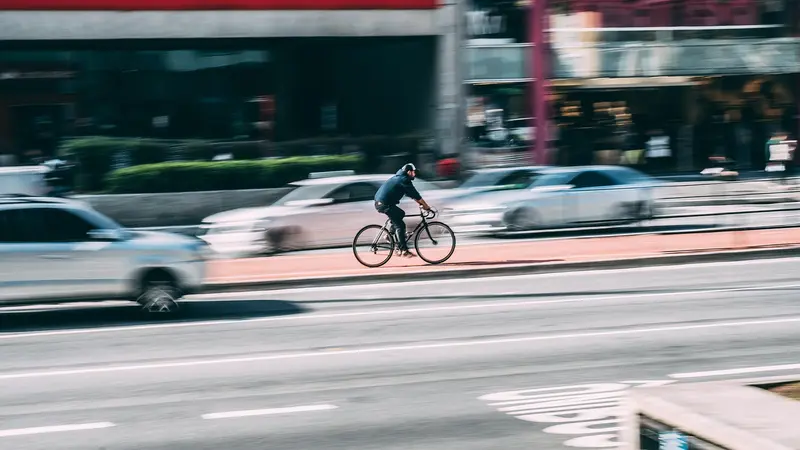
Good morning. This morning, my bus was stuck in traffic for twenty minutes. I was late for my first class, again. While I was waiting, I started to wonder: how will we get around cities in 2050? Today, I'll make three predictions. For each one, I'll show you something that is already happening somewhere in the world. Then I'll talk honestly about what could go wrong.
Your recording
Say this slide out loud, then listen to yourself.
Recordings stay on this device and disappear when you leave the page.
Useful phrases
stuck in traffic
Not able to move because of too many cars.
I started to wonder
I began to ask myself.
already happening
Taking place now, not only in the future.
Words
Highlighted words are on this slide. Tap a word to look it up on Google.
Full script
Read the whole talk.
All slides in one place. Read it through once, then practice slide by slide.
01How We'll Get Around Cities in 2050
Good morning. This morning, my bus was stuck in traffic for twenty minutes. I was late for my first class, again. While I was waiting, I started to wonder: how will we get around cities in 2050? Today, I'll make three predictions. For each one, I'll show you something that is already happening somewhere in the world. Then I'll talk honestly about what could go wrong.
Buenos días. Esta mañana, mi autobús se quedó atascado en el tráfico durante veinte minutos. Llegué tarde a mi primera clase, otra vez. Mientras esperaba, empecé a preguntarme: ¿cómo nos moveremos por las ciudades en 2050? Hoy voy a hacer tres predicciones. Para cada una, les mostraré algo que ya está pasando en alguna parte del mundo. Luego hablaré con sinceridad de lo que podría salir mal.
02Cities Today
Let's start with today. In many big cities, we have the same problems: traffic jams, dirty air, and noise. And cars take up a lot of space. Think about your own family's car. How many hours a day does it actually move? Probably one or two. The rest of the time, it just sits in a parking space. In a crowded city, that's a lot of valuable land used for cars that aren't going anywhere.
Empecemos por el presente. En muchas ciudades grandes tenemos los mismos problemas: atascos, aire sucio y ruido. Y los coches ocupan mucho espacio. Piensen en el coche de su familia. ¿Cuántas horas al día se mueve de verdad? Probablemente una o dos. El resto del tiempo, simplemente está estacionado. En una ciudad llena de gente, eso es mucho terreno valioso usado para coches que no van a ninguna parte.
03Prediction 1: Fewer Cars of Our Own
My first prediction is that fewer people will own a car. Instead, we'll use self-driving shared cars. This may sound like science fiction, but it's already happening. In March 2026, the company Waymo said it was giving about 500,000 paid rides a week in cars with no driver, across ten cities in the United States. You call one with your phone, ride to where you're going, and just get out. The car drives away to pick up the next person, so it doesn't need a parking space.
Mi primera predicción es que menos personas tendrán coche propio. En su lugar, usaremos coches compartidos autónomos. Puede sonar a ciencia ficción, pero ya está pasando. En marzo de 2026, la empresa Waymo dijo que estaba dando unos 500,000 viajes pagados a la semana en coches sin conductor, en diez ciudades de Estados Unidos. Lo pides con el teléfono, viajas a donde vas y simplemente te bajas. El coche se va a recoger a la siguiente persona, así que no necesita un lugar para estacionar.
Source: Waymo, announcement of 500,000 weekly paid rides across ten U.S. cities (March 2026)
04Prediction 2: Streets for People
My second prediction follows from the first. If we don't need so many parking spaces, cities can give that space back to people. Again, one city has already tried this. Pontevedra, a small city in Spain, removed most cars from its center. According to the city, traffic in the center dropped by 97%, and there were no traffic deaths there from 2011 to 2020. I think by 2050, many more cities will look like this, with wide bike lanes, small parks, and streets for walking.
Mi segunda predicción se deriva de la primera. Si no necesitamos tantos estacionamientos, las ciudades pueden devolver ese espacio a las personas. Una vez más, una ciudad ya lo ha probado. Pontevedra, una pequeña ciudad de España, quitó la mayoría de los coches de su centro. Según la ciudad, el tráfico en el centro bajó un 97%, y no hubo muertes por accidentes de tráfico allí de 2011 a 2020. Creo que para 2050, muchas más ciudades se verán así, con carriles bici anchos, parques pequeños y calles para caminar.
Sources: Santé publique France, "Pontevedra, Spain: pedestrians rule the roads, relegating cars to the sidelines" (interview, citing the City of Pontevedra); City of Pontevedra (Concello de Pontevedra), urban mobility model
05Prediction 3: One App for Every Trip
My third prediction is about how we plan trips, and this one is more of a guess. Today, I use one app for the train, another for the bus, and another for renting a bike. In 2050, I think one app will plan your whole trip. It might say, "Take a bike to the station, a train into the city, and a shared car for the last part." And you'll pay once for everything. If it's easier than owning a car, more people will choose it.
Mi tercera predicción trata de cómo planeamos los viajes, y esta es más bien una suposición. Hoy uso una app para el tren, otra para el autobús y otra para alquilar una bici. En 2050, creo que una sola app planeará todo el viaje. Podría decir: «Toma una bici hasta la estación, un tren hasta la ciudad y un coche compartido para la última parte». Y pagarás una sola vez por todo. Si es más fácil que tener un coche, más gente lo elegirá.
06What Could Go Wrong
Of course, this future has risks. It could be expensive. Many taxi and bus drivers could lose their jobs. Self-driving cars could be hacked. And people who don't use smartphones, like some older people, could be left behind. Even Pontevedra has critics. Some people say the traffic didn't disappear, it just moved to the roads outside the center. A good plan has to deal with all of these problems, not just the exciting parts.
Claro, este futuro tiene riesgos. Podría ser caro. Muchos taxistas y conductores de autobús podrían perder su trabajo. Los coches autónomos podrían ser hackeados. Y las personas que no usan teléfonos inteligentes, como algunas personas mayores, podrían quedarse atrás. Incluso Pontevedra tiene críticos. Algunas personas dicen que el tráfico no desapareció, sino que solo se trasladó a las calles fuera del centro. Un buen plan tiene que resolver todos estos problemas, no solo las partes emocionantes.
Source: Associated Press, "Spanish city offers a road map for a future with far fewer cars"
07My Guess at the Timeline
So when will this happen? This is just my guess, so please don't hold me to it. By 2030, I think driverless taxis will be common in many more cities, not just in the United States. By 2040, many city centers will be mostly car-free, like Pontevedra today. And by 2050, using a shared car will feel as normal as taking the bus. Owning your own car in the city might feel a bit like owning a horse does today: possible, but unusual.
Entonces, ¿cuándo pasará esto? Es solo una suposición mía, así que no me lo tomen al pie de la letra. Para 2030, creo que los taxis sin conductor serán comunes en muchas más ciudades, no solo en Estados Unidos. Para 2040, muchos centros urbanos estarán casi libres de coches, como Pontevedra hoy. Y para 2050, usar un coche compartido parecerá tan normal como tomar el autobús. Tener coche propio en la ciudad podría parecerse un poco a tener un caballo hoy: posible, pero poco común.
08Not Faster Cars. Fewer Cars.
To wrap up, driverless taxis and car-free city centers are not just dreams. They already exist in some places. So I believe the future of city travel is not about faster cars. It's about fewer cars. If my predictions are right, the bus I was stuck on this morning won't be stuck anymore, and I won't be late for class. Thank you for listening, and I'm happy to take your questions.
Para terminar, los taxis sin conductor y los centros urbanos sin coches no son solo sueños. Ya existen en algunos lugares. Así que creo que el futuro de los viajes en la ciudad no se trata de coches más rápidos. Se trata de menos coches. Si mis predicciones son correctas, el autobús en el que me quedé atascado esta mañana ya no se quedará atascado, y no llegaré tarde a clase. Gracias por su atención, y con gusto respondo sus preguntas.
Sources: Waymo, announcement of 500,000 weekly paid rides across ten U.S. cities (March 2026); Santé publique France, "Pontevedra, Spain: pedestrians rule the roads, relegating cars to the sidelines" (interview, citing the City of Pontevedra)
More Travel & Places presentations




Cover photo by Pexels on Pixabay
Slide photos by pixaoppa, Michael_Luenen on Pixabay